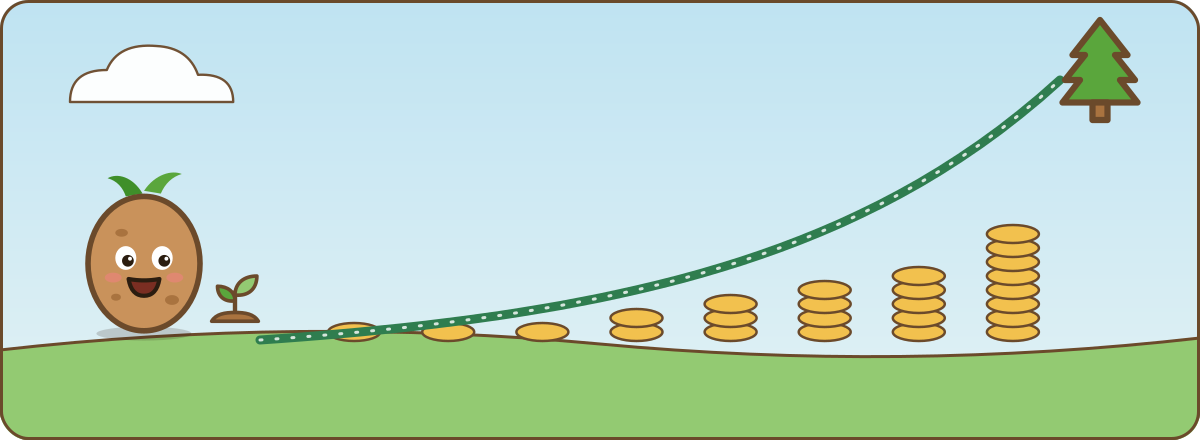
Compound interest is the process by which your money earns returns — and then those returns earn returns — and then those returns earn returns — in an accelerating cycle. It's the fundamental mechanism behind wealth building, and understanding it changes how you think about every financial decision.
Key takeaways
- Growth on growth: compound interest pays returns on your past returns, so the yearly gain gets bigger every year.
- Time beats everything: $10,000 at a hypothetical 7% becomes about $19,700 in 10 years but about $149,700 in 40 years.
- Rule of 72: divide 72 by the rate to estimate the years it takes to double your money.
- Frequency is a small effect: monthly or daily compounding adds a little; the rate and the years add a lot.
- It works against you too: unpaid credit card interest compounds, often faster than any investment grows.
- Shelter it: in a TFSA, RRSP or FHSA, tax does not interrupt the compounding each year.
Simple vs Compound Interest: The Difference
Simple interest is calculated only on your original principal. If you invest $10,000 at 7% simple interest, you earn $700 every year, forever. After 30 years: $31,000 total.
Compound interest is calculated on your principal plus all previously earned interest. In year 1 you earn $700.
In year 2 you earn 7% on $10,700 — that's $749. In year 3, 7% on $11,449 — that's $801.
And so on. After 30 years at 7% compound interest: $76,123. Nearly 2.5x more than simple interest, from the same initial investment.
The Rule of 72: A Mental Shortcut
Divide 72 by your annual interest rate to estimate how many years it takes to double your money. At 7%: 72 ÷ 7 ≈ 10.3 years.
At 10%: 72 ÷ 10 = 7.2 years. At 4%: 72 ÷ 4 = 18 years. It's an approximation, but remarkably accurate for rates between 5–12%.
Here is how close the shortcut gets, compared with the exact doubling time for money that compounds once a year:
| Yearly rate | Rule of 72 estimate | Exact doubling time |
|---|---|---|
| 2% | 36.0 years | 35.0 years |
| 4% | 18.0 years | 17.7 years |
| 6% | 12.0 years | 11.9 years |
| 8% | 9.0 years | 9.0 years |
| 10% | 7.2 years | 7.3 years |
| 12% | 6.0 years | 6.1 years |
| 20% | 3.6 years | 3.8 years |
The rule also works backwards. If you want your money to double in 10 years, you need roughly 72 ÷ 10 = 7.2% a year. And it works for anything that compounds, including prices: at 2% inflation, the cost of living doubles in about 36 years, which is why the Bank of Canada's 2% inflation target still matters to a saver.
The Three Variables That Drive Everything
Time: The most powerful variable. Starting 10 years earlier can more than double your final balance. $500/month from age 25 to 65 at 7%: $1.31M. $500/month from 35 to 65: $610K. Same monthly investment, same return rate — but starting 10 years earlier produces 2.1x the wealth.
Rate: Even small differences in return rate compound into massive differences over decades. At $1,000/month for 30 years: 5% = $832K, 7% = $1.22M, 9% = $1.83M. This is why minimizing investment fees matters so much — a 1% fee is a permanent 1% drag on your compounding.
Principal: Having more invested earlier accelerates everything. A $50,000 head start at 7% becomes $380,000 over 30 years on its own — without adding another dollar.
Compounding Frequency: Does It Matter?
Interest can compound annually, monthly, or daily. The difference matters less than most people think: $10,000 at 7% for 30 years: annual compounding = $76,123 / monthly compounding = $81,165 / daily compounding = $81,645. The difference between annual and daily is $5,522 — meaningful but far less impactful than the rate itself or how long you invest.
The same idea explains why a quoted rate and the rate you actually earn can differ. A savings account that pays 7% a year, compounded monthly, really grows your money by about 7.23% over a year, because each month's interest starts earning interest the next month. Daily compounding brings that to about 7.25%. When you compare two savings accounts or GICs, compare the yearly rate you would actually end up with, not only the headline number.
See your own money grow with our compound interest calculator.
Compound Interest Calculator →How Investment Fees Destroy Compounding
A mutual fund charging 2% annually vs an index ETF at 0.2% doesn't sound like much. But on $100,000 over 30 years at a 7% gross return: the 2% fee fund leaves you with $432,000. The 0.2% ETF leaves you with $739,000. The fee ate $307,000 of your wealth. Compounding works in both directions — it amplifies your gains and amplifies your costs.
Growth at Different Rates and Years
The table below shows what a single $10,000 deposit grows to with no further contributions, compounded once a year. The rates are hypothetical, chosen to show the pattern; they are not a forecast for any investment. A high-interest savings account or GIC usually sits near the low end of this range, and a stock portfolio has historically aimed for the higher end, with far bigger swings along the way.
| Yearly rate | After 10 years | After 20 years | After 30 years | After 40 years |
|---|---|---|---|---|
| 3% | $13,439 | $18,061 | $24,273 | $32,620 |
| 5% | $16,289 | $26,533 | $43,219 | $70,400 |
| 7% | $19,672 | $38,697 | $76,123 | $149,745 |
| 9% | $23,674 | $56,044 | $132,677 | $314,094 |
Two things stand out. First, read across any row: the last 10 years add more money than the first 30 combined at 7% and 9%, because the gains are being earned on a much bigger balance. Second, read down any column: a few extra percentage points look small in year one and enormous by year 40. That is why fees, which come straight off your rate, matter so much over a lifetime. The investment fee calculator shows the effect on your own numbers.
Where Your Money Actually Comes From
Most people add money every month instead of making one deposit. Say you invest $500 a month at a hypothetical 5% a year, compounded monthly:
| Years | You put in | Balance | Growth | Share from growth |
|---|---|---|---|---|
| 10 | $60,000 | $77,641 | $17,641 | 23% |
| 20 | $120,000 | $205,517 | $85,517 | 42% |
| 30 | $180,000 | $416,129 | $236,129 | 57% |
| 40 | $240,000 | $763,010 | $523,010 | 69% |
In the first decade, almost everything in the account is money you saved yourself. In year 26 the growth overtakes your contributions, and from then on compounding does most of the work. This is why your savings rate matters most early on, and why steady monthly investing, also called dollar-cost averaging, is the usual way people put compounding to work.
When Compounding Works Against You
Debt compounds the same way. Interest you do not pay is added to what you owe, and then you pay interest on that interest.
Take a $5,000 credit card balance at a hypothetical 20% yearly rate, compounded monthly (the real yearly cost works out to about 21.9%):
- Pay nothing: the balance grows to about $6,097 after one year, $9,066 after three years and $13,480 after five years.
- Pay $150 a month: it takes 50 months to clear, and you pay about $2,359 in interest.
- Pay $250 a month: it takes 25 months, and the interest drops to about $1,133.
Paying an extra $100 a month cuts the interest by more than half. Few investments reliably earn anything close to a credit card's rate, so paying off high-interest debt is usually the best "return" available. The debt payoff calculator runs these numbers for your own balances, and pay off debt or invest first covers the cases where the answer is less clear.
Compounding in Canada: Tax and Inflation
Two things quietly slow compounding down.
Tax. In a regular taxable account, interest is taxed every year at your marginal tax rate, so part of each year's growth leaves the account before it can compound. Say you earn 7% in interest and your marginal rate is a hypothetical 30%: you keep 4.9% a year. Over 30 years, $10,000 grows to about $42,001 instead of $76,123. Inside a TFSA, the growth is not taxed at all, and inside an RRSP it is taxed only when you withdraw, so the full rate keeps compounding. See how investments are taxed in Canada for how interest, dividends and capital gains differ.
Inflation. A balance that grows at 7% while prices rise at 2% gains only about 5% a year in real buying power. $76,123 after 30 years buys roughly what $42,025 buys today. Nominal figures show the number on your statement; real figures show what it can pay for.
Common Compounding Mistakes
- Waiting to start. The last decade of compounding is the biggest, and you only get it if you start early enough to reach it.
- Interrupting it. Withdrawing growth to spend, or selling in a downturn, resets the snowball to a smaller size.
- Ignoring small rate differences. A 1% fee or a slightly lower savings rate looks trivial in year one and costs a fortune in year 30.
- Forgetting the debt side. Earning 5% on savings while paying 20% on a card balance means your money is compounding backwards.
Related Calculators
FIRE Calculator
Find your financial independence number and retirement timeline.
Net Worth Tracker
Track assets, liabilities, and your wealth over time.
Financial Tracker
Log transactions, get automatic balance sheets and income statements — free and private.
Compound Interest
Watch your investments grow through the power of compounding.
Frequently Asked Questions

Play AlgoPotato right here

No download, no sign-up. Progress saves in your browser and carries over to the full-screen game.