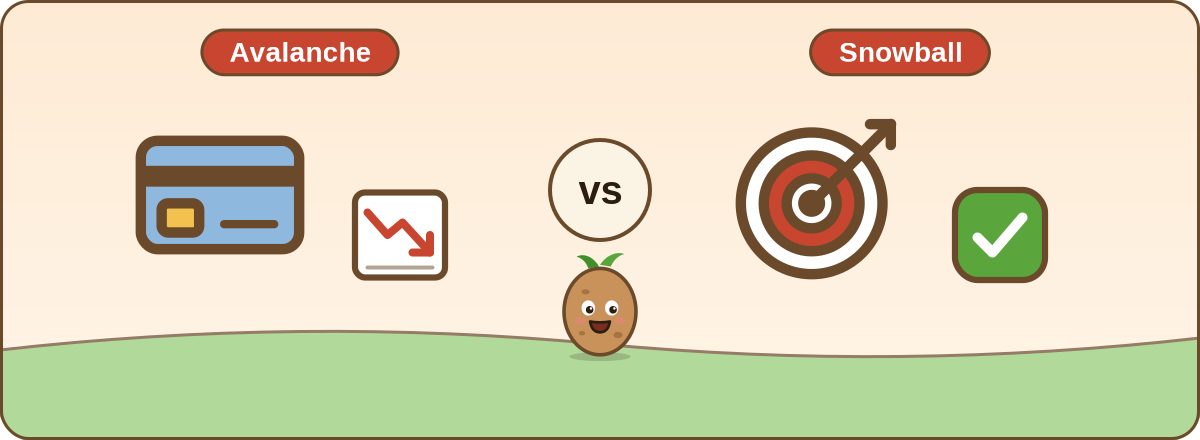
You have several debts and some extra money each month. Where should the extra go? The two best-known answers are the debt avalanche (highest interest rate first) and the debt snowball (smallest balance first). One is cheaper on paper; the other often feels faster. Here are both, worked through on the same Canadian example.
Key takeaways
- Both methods share the same core: pay every minimum, put all extra money on one target, then roll that payment into the next target.
- The avalanche is never more expensive. In our example it saved $424 of interest on $25,500 of debt.
- The snowball gives an earlier win: its first debt was gone in month 5; the avalanche's first was gone in month 17.
- Both finished in the same month here, 33 months, against 60 months on minimum payments alone.
- The rate gap decides how much it matters. With a 20%+ credit card in the mix, start there unless early wins are what keeps you going.
How Each Method Works
Both start the same way: pay the minimum on every debt, so nothing goes into default. Then:
- Avalanche: every extra dollar goes to the debt with the highest interest rate. When it is paid off, its whole payment moves to the next-highest rate.
- Snowball: every extra dollar goes to the debt with the smallest balance. When it is gone, its payment rolls onto the next-smallest, so the payment "snowballs".
The only difference is the order.
A Canadian Example
Four debts, $25,500 in all, with $655 of minimum payments and a $900 monthly budget, so $245 extra each month:
| Debt | Balance | Interest rate | Minimum payment |
|---|---|---|---|
| Credit card | $6,000 | 20.99% | $180 |
| Personal loan | $1,500 | 11.99% | $75 |
| Line of credit | $4,000 | 9.95% | $120 |
| Car loan | $14,000 | 6.99% | $280 |
The avalanche order is credit card, personal loan, line of credit, car loan. The snowball order is personal loan, line of credit, credit card, car loan. Interest is charged monthly, and each minimum stays fixed so the comparison is easy to follow.
The Results
| Avalanche | Snowball | Minimums only | |
|---|---|---|---|
| Debt-free in | 33 months | 33 months | 60 months |
| Total interest | $3,445 | $3,869 | $6,560 |
| First debt paid off | Credit card, month 17 | Personal loan, month 5 | n/a |
Three things stand out:
- The avalanche saved $424. Every extra dollar went to the 20.99% card first, where it saved the most.
- Both finished in month 33. The biggest debt, the car loan, is last in both orders and sets the finish line.
- The snowball gave a win a year sooner. The $1,500 loan was gone in five months; the avalanche's first payoff took 17.
And either plan beat paying only the minimums by more than two years and over $2,600 of interest. The method matters less than having one.
Which Should You Choose?
Choose the avalanche if your rates are far apart, especially with a credit card at 20% or more, and you can stay motivated by watching the total fall rather than by closing accounts.
Choose the snowball if you have tried before and stopped, or if your rates are close together. A 2012 study of about 6,000 people in a debt settlement program (Gal and McShane, Journal of Marketing Research) found that closing whole accounts predicted paying everything off, whatever the dollar amounts. The authors note this makes most sense when the rate gap is modest.
A middle path: knock out one tiny balance for the early win, then switch to the avalanche.
Canadian Context
- Very high-rate debt goes first, whatever the method. Since January 1, 2025, new loans in Canada cannot charge more than 35% APR, and payday loans are capped at $14 per $100 borrowed. Anything near those levels is an emergency.
- 0% balances can wait. A 0% promotional loan or the interest-free federal part of a Canada Student Loan costs nothing to carry, so pay the minimum and send the extra elsewhere.
- Consolidation can beat both, if a line of credit or consolidation loan charges less than your cards and you stop using the cards afterwards.
How AlgoPotato Teaches It
You start AlgoPotato with three debts: a $1,000 credit card at 20.99%, an interest-free federal student loan and a car loan at a 0% promotional rate. The game's "Best next move" tells you to pay the card first: the avalanche in one line. Paying off the 0% loans early earns nothing, and the game lets you feel why.
To try your own numbers, the debt payoff calculator compares both orders. If you are also wondering whether to invest instead, read Pay Off Debt or Invest First?.
Run Your Debts
Debt Payoff Calculator
Your debt-free date, avalanche against snowball.
Net Worth Tracker
Watch the debt shrink and your net worth climb.
Frequently Asked Questions

This article is educational content, not personalized financial advice. The example uses invented balances and rates and keeps each minimum payment fixed to make the comparison easy to follow; your lenders' actual minimums and rates will differ. If debt feels unmanageable, a non-profit credit counselling agency can help.
Play AlgoPotato right here

No download, no sign-up. Progress saves in your browser and carries over to the full-screen game.