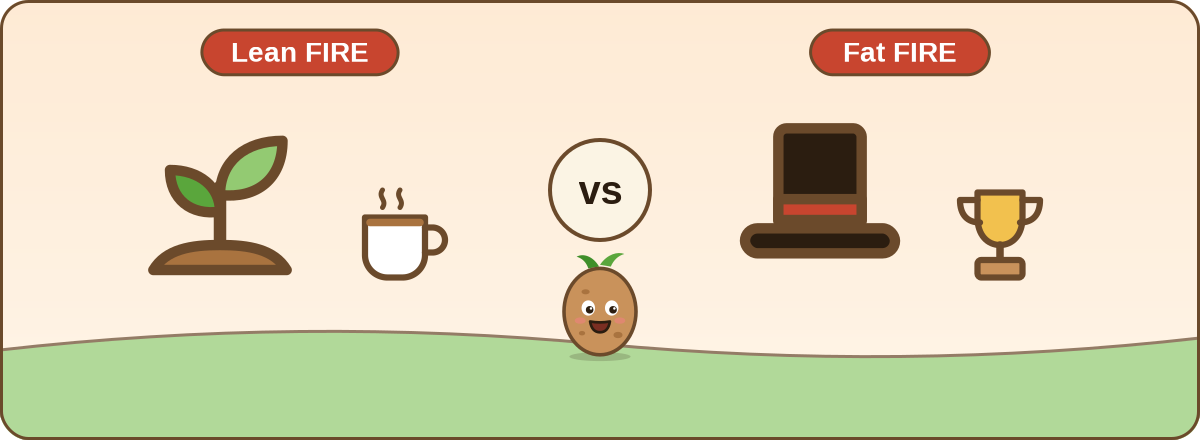
Not all FIRE is equal. The same movement that celebrates retiring at 35 on $30,000/year also includes people building $5M+ portfolios before calling it quits. The spectrum from "Lean FIRE" to "Fat FIRE" represents fundamentally different philosophies about the relationship between money, time, and lifestyle — and choosing the right one matters enormously.
Key takeaways
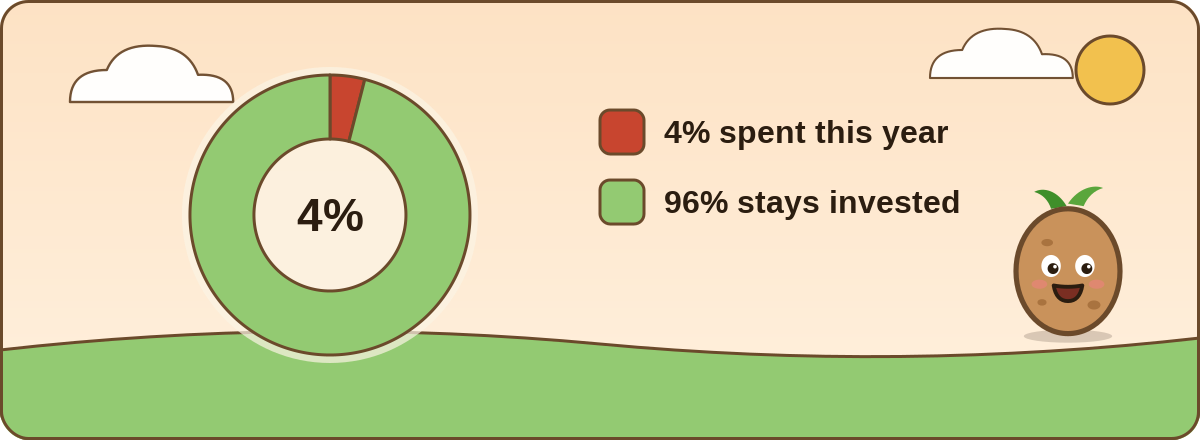
- Same formula, different budgets: every version of FIRE needs about 25 times annual spending at a 4% withdrawal rate.
- Lean is fast, Fat is slow: saving $4,000 a month at an assumed 5% real return, a $36,000 budget is reachable in about 13 years and a $120,000 budget in about 29.
- Lean has less room for error: there is little left to cut when markets drop or costs rise.
- Fat costs years, not just dollars: the extra portfolio usually means a decade or more of extra work.
- CPP and OAS matter more to Lean FIRE, because the same pension covers a bigger share of a small budget.
- Most people land in between, or start lean and earn a little on the side.
What Is Lean FIRE?
Lean FIRE means retiring on a minimal budget — typically defined as annual expenses under $40,000 for a single person, or under $60,000 for a couple. The required portfolio is smaller (often $750K–$1M), which means you can reach FIRE much faster. The trade-off is a permanently frugal lifestyle in retirement.
Lean FIRE works best for people who genuinely enjoy minimalism, live in low cost-of-living areas, have no or grown children, own their home, and find fulfilment in experiences and relationships rather than consumption. It requires a real acceptance that your lifestyle won't significantly improve after you retire — because the math doesn't allow it.
What Is Fat FIRE?
Fat FIRE means retiring with enough to maintain or improve a comfortable, relatively high-spending lifestyle. Commonly defined as $100,000+/year in retirement spending, which requires a $2.5M+ portfolio at a 4% withdrawal rate. Fat FIRE prioritizes freedom of lifestyle over speed — most Fat FIRE achievers are high earners who worked longer but retired with far more.
The Numbers Side by Side
| Lean FIRE | Regular FIRE | Fat FIRE | |
|---|---|---|---|
| Annual Expenses | Under $40K | $40K–$80K | $100K+ |
| Portfolio Needed (4%) | $750K–$1M | $1M–$2M | $2.5M+ |
| Time to FIRE (50% SR) | ~12–15 yrs | ~17–22 yrs | ~25–35 yrs |
| Lifestyle Flexibility | Low | Moderate | High |
| Sequence of Returns Risk | Higher | Moderate | Lower |
The Hidden Risk of Lean FIRE
Retiring on a tight budget creates real vulnerability. A bad sequence of market returns in the first few years of retirement — combined with no income — can permanently damage your portfolio. Lean FIRE retirees have almost no buffer. Many end up doing part-time "barista" work not by choice, but because the math gets tighter than expected. Healthcare costs, home repairs, and inflation all create pressure that a $1M portfolio at 4% withdrawal doesn't absorb easily.
The Hidden Cost of Fat FIRE
Fat FIRE often means working 10–15 extra years to build a much larger portfolio. Those are years of your life — potentially your healthiest, most energetic years. Many people on the Fat FIRE path question whether the extra security is worth the extra time. There's a reason many FIRE achievers say they wish they'd pulled the trigger sooner.
Use our FIRE calculator to model both scenarios with your actual numbers.
FIRE Calculator →Lean, Regular and Fat FIRE Budgets Compared
What does each lifestyle actually buy? Below are three sample yearly budgets for a couple with a paid-off home. They are illustrations to make the labels concrete, not price quotes: your own costs depend on your city, your home and your habits.
| Yearly spending | Lean FIRE | Regular FIRE | Fat FIRE |
|---|---|---|---|
| Housing (property tax, utilities, upkeep, insurance) | $9,600 | $18,000 | $36,000 |
| Groceries and eating out | $7,200 | $10,800 | $18,000 |
| Transportation | $4,800 | $7,200 | $14,400 |
| Health, dental, drugs and insurance | $3,600 | $4,800 | $9,600 |
| Travel and fun | $3,600 | $9,000 | $24,000 |
| Phone, clothing, gifts and everything else | $4,200 | $6,000 | $12,000 |
| Buffer for surprises | $3,000 | $4,200 | $6,000 |
| Total | $36,000 | $60,000 | $120,000 |
The biggest gaps are housing and travel. Lean FIRE usually means one modest home, one older car and travel by road rather than air. Fat FIRE leaves room for a larger home, two newer cars, regular flights and helping family.
The FIRE Number Each Budget Needs
Multiply spending by 25 for a 4% withdrawal rate, or by about 28.6 for a more cautious 3.5%. Our guide to the 4% rule in 2026 explains when the lower rate makes sense.
| Budget | Yearly spending | Target at 4% | Target at 3.5% |
|---|---|---|---|
| Lean FIRE | $36,000 | $900,000 | about $1,028,600 |
| Regular FIRE | $60,000 | $1,500,000 | about $1,714,300 |
| Fat FIRE | $120,000 | $3,000,000 | about $3,428,600 |
These budgets are after-tax spending. If most of your money will come out of an RRSP or RRIF, each withdrawal is taxed as income, so the pre-tax portfolio you need is larger. That gap grows with the budget, because bigger withdrawals reach higher tax brackets. See how investments are taxed in Canada.
How Long Each Takes to Reach
Here is how long each target takes from a $0 start, investing the same amount at the end of every month. The two figures in each cell use an assumed real return (after inflation) of 5% and 7% a year, compounded monthly, with no fees or taxes. These returns are assumptions, not forecasts.
| Invested per month | Lean ($900,000) | Regular ($1,500,000) | Fat ($3,000,000) |
|---|---|---|---|
| $2,500 | 18.6 / 16.4 years | 25.4 / 21.9 years | 36.4 / 30.3 years |
| $4,000 | 13.4 / 12.2 years | 19.1 / 16.8 years | 28.8 / 24.5 years |
| $6,000 | 9.8 / 9.1 years | 14.4 / 13.1 years | 22.8 / 19.9 years |
At $4,000 a month and an assumed 5% return, the gap between Lean and Fat FIRE is about 15 years. That is the real price of the bigger budget. In practice, people chasing Fat FIRE usually earn and save more than this, which narrows the gap. Run your own numbers in the FIRE calculator, or see how long it takes to reach $1 million for a fuller table.
Canadian Costs to Plan For
Health care. Provincial plans cover doctor visits and hospital care, but much of dental, vision, prescription drugs and paramedical care depends on your province and, while you work, on your employer's plan. Early retirees lose the workplace plan, so both budgets above include a line for health and dental. Lean budgets feel this most.
Government pensions. CPP and OAS start later in life, but they matter more to a lean budget. For example, if a couple expected $15,000 a year combined from them (a hypothetical figure; check your own statements), that would cover about 42% of a $36,000 budget but only 12.5% of a $120,000 one. A lean retiree's portfolio has to carry the full load only until the pensions begin.
Taxes. Low spending usually means low taxable income, so Lean FIRE retirees often pay little tax, especially if much of their money is in a TFSA. Fat FIRE retirees with large RRSPs can face higher brackets for decades.
Which One Suits You? A Quick Test
Lean FIRE tends to suit you if you already live on close to the lean budget without feeling deprived, your housing is cheap or paid off, you have no dependants or they are grown, and you are happy to earn some income if markets go badly.
Fat FIRE tends to suit you if you have a high income you do not mind keeping for longer, you expect big costs such as children's education or helping parents, or you know that a tight budget would make you unhappy.
Neither, exactly? Many people pick a middle path. Barista FIRE covers part of your spending with part-time work. Coast FIRE means saving hard early, then working only to cover current costs while your investments grow. The Coast FIRE calculator shows when you would reach that point.
Common Mistakes
- Budgeting Lean FIRE from today's expenses while you still have a workplace health plan. Price health and dental on your own.
- Leaving out irregular costs. Roofs, cars and appliances all need replacing. Put a yearly amount aside for them.
- Choosing Fat FIRE by default. Ask whether each extra $10,000 of yearly spending is worth the extra $250,000 of portfolio, and the years it takes to build.
- Forgetting inflation. Plan in today's dollars with real returns, and remember the withdrawal amount rises with prices each year.
- Assuming the label is permanent. Plans change: a little part-time income or a move to a cheaper area can turn Lean into comfortable, and a Fat budget can be trimmed if you find you do not use it.
Once you have a target, the retirement income calculator shows how much a given portfolio could pay you each year. For the basics behind all of this, start with What Is the FIRE Movement?, and if you want to move fast, read Can You Achieve Financial Independence by 30?
Related Calculators
FIRE Calculator
Find your financial independence number and retirement timeline.
Net Worth Tracker
Track assets, liabilities, and your wealth over time.
Financial Tracker
Log transactions, get automatic balance sheets and income statements — free and private.
Compound Interest
Watch your investments grow through the power of compounding.
Frequently Asked Questions


Play AlgoPotato right here

No download, no sign-up. Progress saves in your browser and carries over to the full-screen game.