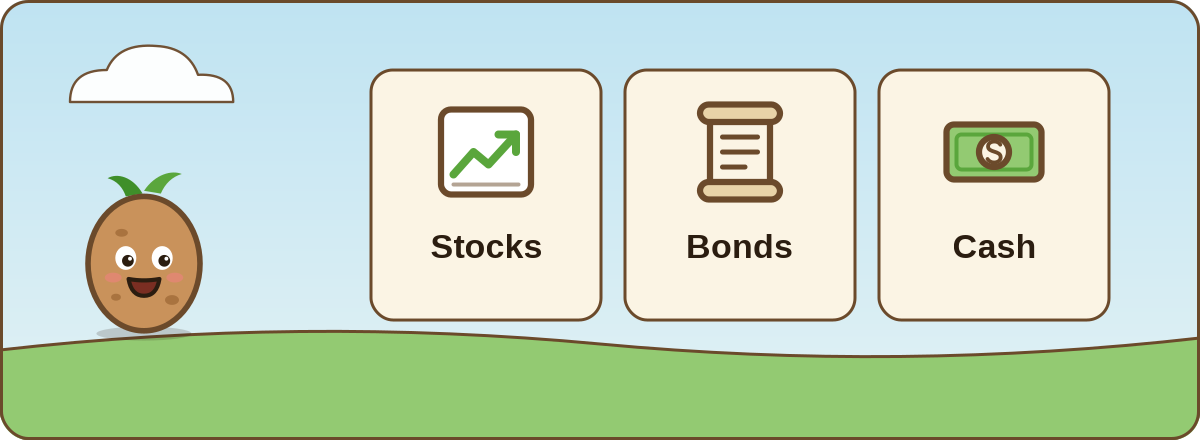
The way an investor divides their portfolio across different categories of assets — such as stocks, bonds, cash, or real estate — usually expressed as target percentages, based on their goals, time horizon, and comfort with risk.
Before picking specific investments, most people first decide the broader recipe: what percentage goes into growth-oriented stocks versus steadier bonds versus cash sitting on the sidelines. Someone decades from retirement can typically afford a more stock-heavy mix, since they have time to ride out downturns; someone close to needing the money often shifts toward a steadier mix to protect what they've already built.
A common example is a "50/25/25" split — 50% in a growth-focused fund, 25% in one income-focused fund, 25% in another — versus a more conservative "60/40" stocks-and-bonds mix often used closer to retirement. Neither is universally "right"; the right split depends entirely on the individual's timeline and risk tolerance.
Asset allocation is the percentage split of a portfolio between broad types of investments, such as stocks, bonds and cash. It is usually the first and most important investing decision, because it sets how much the portfolio is likely to swing and how much growth it is aiming for.
How asset allocation works
Each broad asset class behaves differently:
| Asset class | Main role | Typical trade-off |
|---|---|---|
| Stocks | Long-term growth | Larger and more frequent drops |
| Bonds | Income and stability | Lower expected growth |
| Cash, GICs, savings | Safety and short-term needs | Can lose ground to inflation |
An allocation is written as target percentages, such as 80/20 (80% stocks, 20% bonds) or 60/40. The target reflects three things: when the money is needed, how much loss the investor can sit through without selling, and what the money is for. A down payment due in two years and a retirement fund for someone aged 30 call for very different mixes, even for the same person.
Because each asset class moves at its own pace, the actual mix drifts away from the target over time. Pulling it back is called rebalancing.
A worked example
Say an investor has $100,000 with a 60/40 target: $60,000 in stocks and $40,000 in bonds. Over a year, assume stocks rise 20% and bonds are flat (both figures are assumptions for illustration).
- Stocks: $60,000 x 1.20 = $72,000
- Bonds: $40,000 (unchanged)
- Total: $72,000 + $40,000 = $112,000
- New mix: $72,000 / $112,000 = 64.29% stocks and $40,000 / $112,000 = 35.71% bonds (rounded to two decimals)
To restore 60/40 on the new total:
- Target stocks: $112,000 x 60% = $67,200
- Target bonds: $112,000 x 40% = $44,800
- Move $72,000 - $67,200 = $4,800 from stocks to bonds
Without that step, a good run for stocks quietly turns a 60/40 portfolio into something riskier than the investor chose. Another option is to send new contributions to the bond side until the mix is back on target, which avoids selling.
Asset allocation in Canada
Canadian investors face a few extra layers on top of the stock and bond split:
- Home versus world. Many Canadian portfolios decide how much to hold in Canadian stocks versus US and international stocks. A portfolio that leans heavily on one country depends on that one economy, so this choice affects diversification as much as it affects risk.
- Which account holds what. US dividends lose 15% to US withholding tax in a TFSA, FHSA or non-registered account, but are exempt in an RRSP or RRIF when US-listed securities are held directly. Canadian-listed ETFs holding US stocks still lose that 15% inside the fund. This is why some investors place US holdings in their RRSP. See withholding tax for the details.
- One-fund options. All-in-one ETFs hold a fixed allocation and rebalance internally, so the investor only picks the mix. Our guide to all-in-one ETFs in Canada explains how they are built.
- Cash counts too. Money in a high-interest savings account or GIC is part of the allocation. Our overview of Canadian asset classes covers what each one is for.
Common mistakes
- Picking funds before picking a mix. The split between stocks and bonds drives most of a portfolio's ups and downs; the specific fund choice matters less.
- Choosing a mix based on last year's returns. An allocation that only feels right after a good year may be abandoned after a bad one.
- Ignoring accounts held elsewhere. A workplace pension, an RRSP at one firm and a TFSA at another all belong to one allocation.
- Never rebalancing. Drift slowly changes the risk level without anyone deciding to.
- Counting the same thing twice. Two ETFs that track similar indexes add complexity without adding diversification.
How it connects
Asset allocation is the plan; diversification and rebalancing are how the plan is kept honest. It also shapes total return over time, since a stock-heavy mix aims for more growth with bigger swings along the way. A worked three-fund example is in the 50/25/25 portfolio.