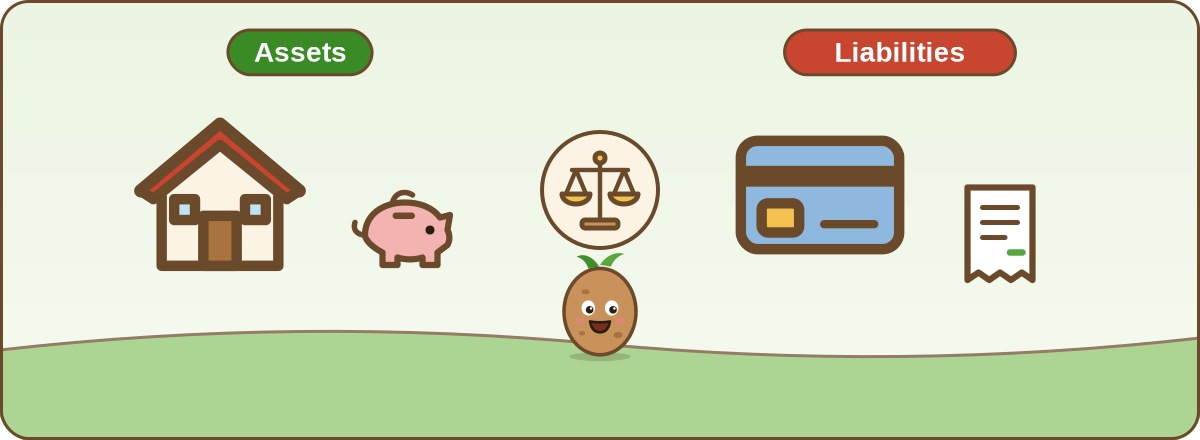
The total value of everything someone owns (assets) minus everything they owe (liabilities) — calculated as assets minus liabilities, at a single point in time.
Income tells you how much money flows in each month; net worth tells you how much you've actually kept and built up over time. It's a snapshot, not a speed — add up your cash, investments, home value, and anything else of worth, subtract your mortgage, credit card balance, and any other debt, and what's left is your net worth. It can be negative (owing more than you own) especially early in adulthood, and that's normal.
$50,000 in investments, $20,000 in cash, and a $300,000 home ($370,000 in assets) minus a $250,000 mortgage and $10,000 in other debt ($260,000 in liabilities) leaves a net worth of $110,000.
Net worth is the value of everything you own minus everything you owe. It is a single snapshot of your finances on one date, and tracking it over time shows whether you are building wealth.
How net worth works
The formula is short: net worth = total assets - total liabilities.
- Assets are things with value you could turn into money: cash, investments, registered accounts, your home, a car, and money owed to you.
- Liabilities are what you owe: mortgage, car loan, student loans, lines of credit and credit card balances.
Income is not part of the formula. A high salary does not raise net worth unless some of it is kept. That is why net worth is a better measure of progress than income, and why it often grows faster once savings start compounding.
Values should be realistic. Use current market values for investments, a cautious estimate of what the home would sell for, and what a car would fetch today, not what you paid.
A worked example
Here is a Canadian household's balance sheet on one date. All figures are for illustration.
| Assets | Value |
|---|---|
| TFSA | $42,000 |
| RRSP | $65,000 |
| Chequing and savings | $6,500 |
| Car | $15,000 |
| Home | $520,000 |
| Total assets | $648,500 |
| Liabilities | Balance |
|---|---|
| Mortgage | $390,000 |
| Car loan | $11,000 |
| Credit card | $2,300 |
| Total liabilities | $403,300 |
Step by step:
- Total assets: $42,000 + $65,000 + $6,500 + $15,000 + $520,000 = $648,500.
- Total liabilities: $390,000 + $11,000 + $2,300 = $403,300.
- Net worth: $648,500 - $403,300 = $245,200.
Two adjustments give a sharper picture:
- After-tax RRSP. RRSP withdrawals are taxed as income, so the $65,000 is not all spendable. Assuming 30% tax on withdrawals (an assumption, since the real rate depends on income at withdrawal), the RRSP is worth about $65,000 x 0.70 = $45,500 after tax. Net worth becomes $245,200 - $19,500 = $225,700.
- Liquid net worth. Leaving out the home, the car and their loans: $42,000 + $65,000 + $6,500 - $2,300 = $111,200. This is closer to the money that could fund a future FIRE number.
Net worth in Canada
Canadian accounts are not all equal when you add them up:
- TFSA balances are after tax. Withdrawals are tax-free.
- RRSP balances are before tax. Withdrawals are added to income, so some people discount them as above.
- FHSA balances are tax-free if used for a qualifying home purchase, and taxable otherwise.
- Non-registered accounts may carry unrealized capital gains, which are taxed when sold. In 2026, half of a capital gain is included in income (a 50% inclusion rate).
- Pensions and CPP. Future pension and CPP payments are valuable but hard to price, so many people track them separately rather than adding a guess to net worth.
Bank deposits and investment accounts also have different protections (CDIC covers eligible deposits up to $100,000 per category per member institution, while CIPF covers up to $1 million per account category if a member firm fails), but neither changes the value you record.
Common mistakes
- Counting the purchase price. A car bought for $35,000 is worth what it would sell for now.
- Forgetting small debts. Credit cards, buy-now-pay-later plans and taxes owed are liabilities too.
- Treating the RRSP as fully spendable. Part of it belongs to future tax.
- Checking it too often. Daily market moves add noise. Monthly or quarterly updates show the real trend.
- Comparing with others instead of your past self. Age, city and career all change what a "normal" figure looks like.
How it connects
Net worth rises in two ways: growing assets and paying down liabilities. Your savings rate drives both. To see how your figure compares with others your age, read net worth by age in Canada, and to track it over time, use the net worth tracker.
Frequently Asked Questions
Related Terms
Track your own net worth over time.
Try the Net Worth Tracker →