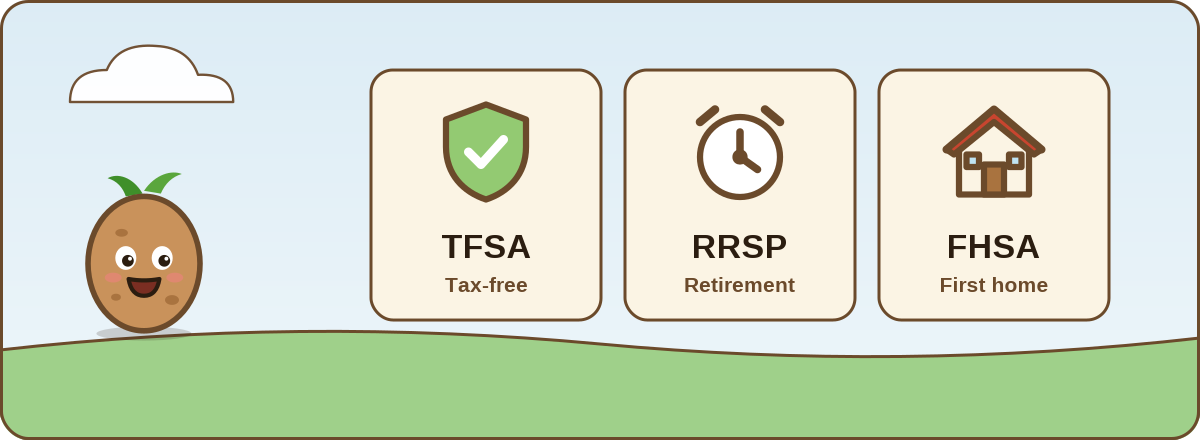
An investment account registered with the Canadian government that receives special tax treatment — such as tax-free growth, tax-deductible contributions, or both — in exchange for following specific rules around contribution limits and, in some cases, withdrawal conditions.
It's the umbrella term for accounts like the TFSA, RRSP, and FHSA — each with its own rules, but all sharing one thing: the government gives up some tax revenue on money held inside them, as an incentive to save. The trade-off for that tax break is a set of limits on how much you can put in, and sometimes rules about how the money can come out.
A non-registered account has no such deal — no contribution limits, no special tax break, but full flexibility and standard taxation on any income or gains each year. Most long-term investors try to fill up their registered room first, since the tax savings there are usually worth more than the flexibility of a non-registered account.
A registered account is a Canadian savings or investment account registered with the federal government that gets special tax treatment, such as tax-free growth or tax-deductible contributions, in return for contribution limits and rules on withdrawals. The best known are the TFSA, RRSP and FHSA.
How registered accounts work
A registered account is a wrapper. Inside it you can hold cash, GICs, ETFs, stocks or bonds. What changes is how the government taxes the money going in, growing inside, and coming out.
Each account makes a different deal:
| Account | Contributions | Growth | Withdrawals |
|---|---|---|---|
| TFSA | Not deductible | Tax-free | Tax-free |
| RRSP | Deductible | Tax-deferred | Taxed as income |
| FHSA | Deductible | Tax-free | Tax-free for a qualifying home |
In exchange, each has a yearly cap, tracked as contribution room. For 2026 the figures are:
- TFSA: $7,000 new room for the year; $109,000 cumulative for someone who has been 18 or older and resident since 2009 and has never contributed.
- RRSP: 18% of the previous year's earned income, up to $33,810, minus any pension adjustment, plus unused room carried forward.
- FHSA: $8,000 a year and $40,000 lifetime, with up to $8,000 of unused room carrying forward (so at most $16,000 in one year).
Going over the limit costs 1% per month on the excess in a TFSA, and on RRSP excess above a $2,000 lifetime buffer.
A worked example
Suppose an investor in 2026 puts $20,000 into an ETF, and it later grows to $30,000 (an assumed outcome for illustration). They sell, for a $10,000 gain.
In a non-registered account:
- Capital gain: $30,000 - $20,000 = $10,000
- Taxable portion at the 50% inclusion rate: $10,000 x 0.50 = $5,000
- If their federal marginal rate is 20.5% (2026 taxable income between $58,523 and $117,045), federal tax is $5,000 x 0.205 = $1,025, with provincial tax added on top.
In a TFSA: the same $10,000 gain is never taxed, so the $1,025 of federal tax (plus the provincial share) stays invested.
In an RRSP: no tax on the sale itself. Tax applies later, when money is withdrawn, at the investor's income tax rate in that year.
Registered accounts in Canada
Some rules apply across all of them:
- Room is personal. Each person has their own limits, tracked by the CRA.
- Room carries forward. Unused TFSA and RRSP room rolls into future years; FHSA carry-forward is capped at $8,000.
- Foreign reporting. Property held inside an RRSP or TFSA is excluded from the T1135 foreign property report.
- US dividends. US-listed securities held directly in an RRSP or RRIF are exempt from the 15% US withholding tax; in a TFSA or FHSA it still applies.
The post comparing the TFSA, RRSP and FHSA goes into more depth, and the RRSP vs TFSA calculator runs the numbers for a given income.
None of this makes a non-registered account a bad choice. It has no contribution limits and no rules on when money comes out, so it is often where savings go once registered room is full, or where money for a specific shorter-term purpose sits. The trade-off is simply that its income and realized gains are taxed along the way.
Common mistakes
- Treating a TFSA as only a savings account. It can hold investments, and some people leave it in low-interest cash for years.
- Over-contributing. Withdrawn TFSA amounts only return as room on January 1 of the next year; putting them back sooner can trigger the 1% monthly tax.
- Assuming RRSP withdrawals are free. They are added to taxable income in the year they come out.
- Ignoring the account when choosing investments. Where an asset sits can change the tax on it, such as US dividends in a TFSA versus an RRSP.
How it connects
Registered accounts are the main tool Canadians use to reduce tax on long-term savings. Filling them in a sensible order is part of how investments are taxed in Canada, and the order often matters more than which ETF goes inside.