What Is a Cash-Generating Asset?
A cash-generating asset is anything you own that pays you money while you keep owning it: interest, dividends, rent, royalties or business profits. Gold, raw land, collectibles and most crypto are not cash-generating: they pay you only if you sell them for more than you paid.
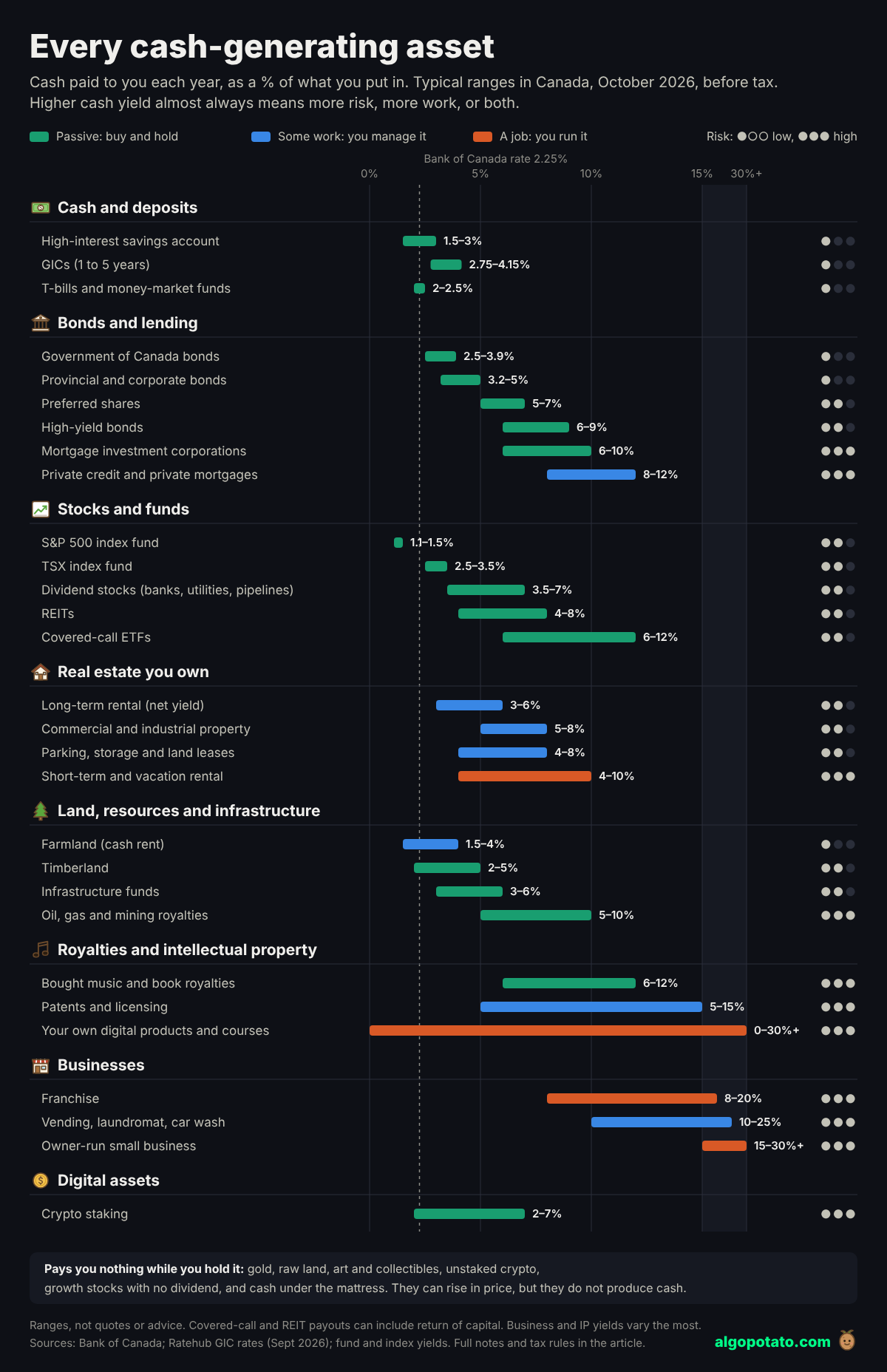
There are eight families of cash-generating assets: cash and deposits, bonds and lending, stocks and funds, real estate, land and resources, royalties, businesses, and digital assets. Below is every one, with what it pays, how risky it is, how much work it takes, and how Canada taxes it. Yields are typical ranges in October 2026, when the Bank of Canada rate is 2.25%. They are a map, not quotes or advice: check current rates before you buy.
Key takeaways
- Safest: savings accounts and GICs, about 1.5–4.15% a year, insured by CDIC up to $100,000 per category.
- Passive middle: bonds, dividend stocks, REITs and covered-call ETFs pay about 3–12%, with more risk the higher you go.
- Highest: rentals, royalties and businesses can pay 10–30% or more, but most of that is pay for your work, and failures are common.
- A yield far above similar assets is usually a warning, not a bargain.
- Tax decides what you keep: put interest in a TFSA or RRSP first; Canadian dividends get a tax credit; half of capital gains are taxed.
- To live on income, divide yearly spending by the yield: $40,000 at 4% needs $1,000,000.
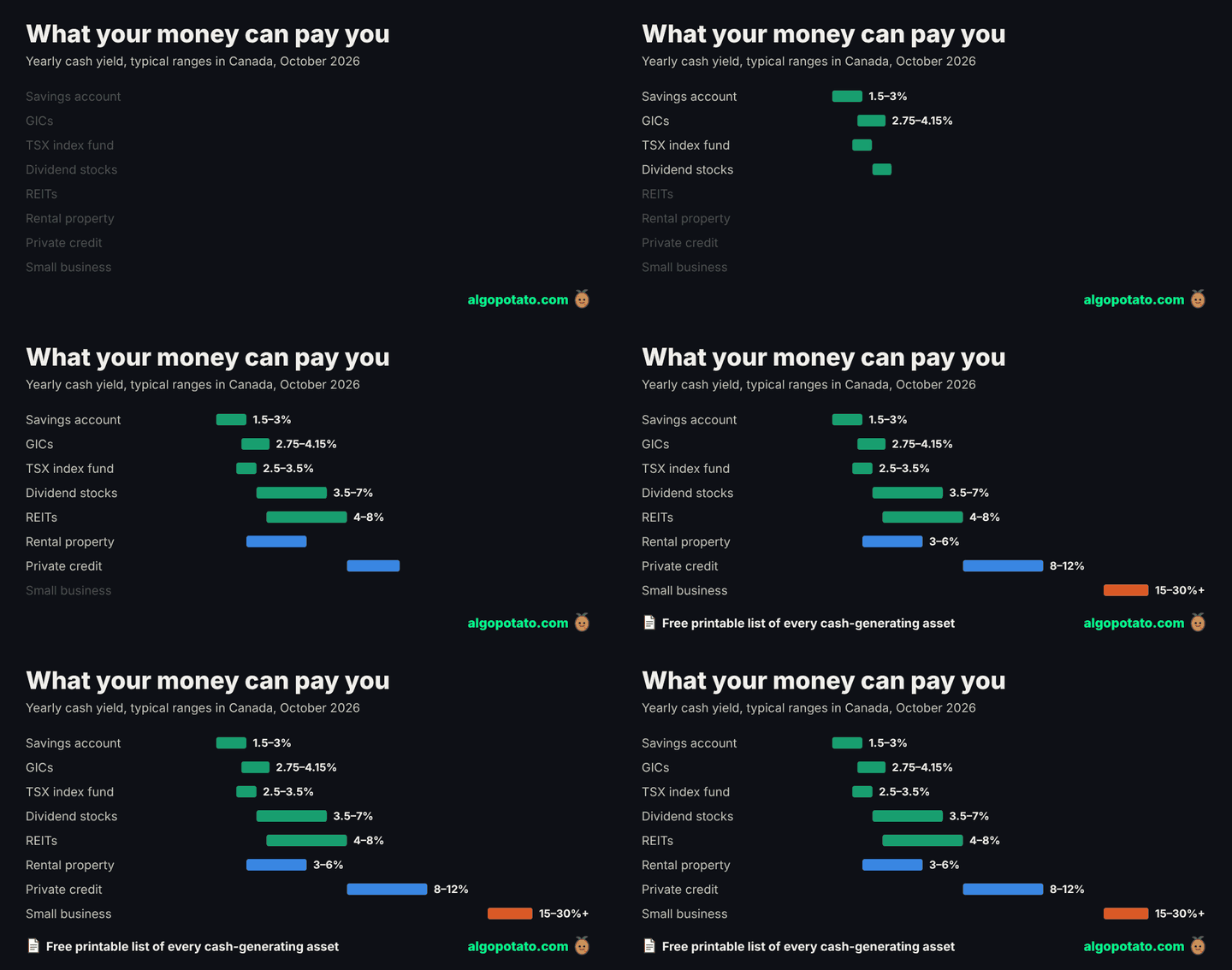
Get this list as a free printable PDF (9 pages, with a worksheet) ↓
How to Read a Cash Yield
Cash yield is the cash an asset pays you in a year divided by what it costs. A $10,000 GIC paying $380 a year yields 3.8%. A $50 share paying $2 in dividends yields 4%.
Three things the yield alone does not tell you:
- Total return. Cash yield plus or minus the change in price. A stock paying 1.3% that grows 9% a year beats a bond paying 5% with no growth. Read more on total return.
- Whether it lasts. A yield far above similar assets usually means the market expects a cut. That is a yield trap: you buy for 11%, the payout is halved, and the price falls too.
- Return of capital. Some payouts are partly your own money handed back. It is not taxed now, but it lowers your adjusted cost base, so you pay more capital gains tax when you sell.
And after inflation (around 2% to 3%), a 3% yield is close to a 0% real return. The real question for every asset below is: what do I keep after inflation, tax and fees?
1. Cash and Deposits
The safest place for money you need soon, and the base of any emergency fund.
| Asset | Typical cash yield | Risk | Effort | How it pays you |
|---|---|---|---|---|
| High-interest savings account (HISA) | 1.5–3% | Low | None | Interest, monthly |
| GICs, 1 to 5 years | 2.75–4.15% | Low | None | Interest, yearly or at maturity |
| HISA ETFs and money-market funds | 2–2.5% | Low | None | Monthly distributions |
| Government of Canada T-bills | 2–2.5% | Very low | Low | Bought at a discount, paid face value |
| US-dollar savings and GICs | 2.5–4% | Low, plus currency risk | None | Interest in US dollars |
In September 2026 the best 1-year GIC in Canada paid 3.65% and the best 5-year GIC paid 4.15% (Ratehub). Big-bank posted rates are usually lower, and big-bank savings accounts often pay well under 1% outside promotions. Deposits at a CDIC member are insured up to $100,000 per category per institution: see CDIC vs CIPF.
2. Bonds and Lending
You lend money; the borrower pays you interest. The risk is that they cannot pay you back, and that rising rates lower the price of the bond if you sell early.
| Asset | Typical cash yield | Risk | Effort | How it pays you |
|---|---|---|---|---|
| Government of Canada bonds | 2.5–3.9% | Low | None | Interest, twice a year |
| Provincial and investment-grade corporate bonds | 3.2–5% | Low to medium | None | Interest, twice a year |
| Preferred shares | 5–7% | Medium | Low | Fixed dividends, quarterly |
| High-yield ("junk") bonds | 6–9% | Medium to high | Low | Interest |
| Mortgage investment corporations (MICs) | 6–10% | High | Low | Monthly distributions from mortgage interest |
| Private credit, private mortgages, peer-to-peer loans | 8–12% | High | Some | Interest |
| Life annuity (from an insurer) | About 6–7% at 65 | Low | None | Monthly payments for life |
Two warnings. Canada's 10-year bond yield moved between about 3.8% and 4% in October 2026, so longer bonds pay more than savings today but fall in price if rates rise. And an annuity's payout is not a yield in the same sense: much of each payment is your own money coming back, and nothing is left when you die unless you buy a guarantee. Read Bonds, GICs, HISA ETFs in Canada for how to pick between them.
3. Stocks and Funds
You own part of a company and get a share of the profit it pays out. Payouts can grow over time, which bonds cannot do, but they can also be cut.
| Asset | Typical cash yield | Risk | Effort | How it pays you |
|---|---|---|---|---|
| S&P 500 index fund | 1.1–1.5% | Medium | None | Quarterly dividends |
| TSX index fund | 2.5–3.5% | Medium | None | Quarterly dividends |
| Canadian dividend stocks (banks, utilities, pipelines, telecoms) | 3.5–7% | Medium | Low | Quarterly dividends |
| REITs (real estate investment trusts) | 4–8% | Medium | Low | Monthly distributions |
| Covered-call ETFs | 6–12% | Medium | None | Monthly distributions from dividends and option premiums |
| Business development companies and royalty trusts (US) | 7–11% | High | Low | Quarterly distributions |
The S&P 500 pays little cash because US companies buy back shares instead, so most of its return comes from price. Canadian banks and pipelines pay more and get the dividend tax credit. Covered-call ETFs trade away part of the upside for income: in a strong year they lag the market, and part of the payout is often return of capital. See The $75,000 dividend income portfolio for what living on dividends actually takes.
4. Real Estate You Own
Rent minus every cost is your cash flow. Net yield is that cash flow divided by the price (the cap rate), before mortgage payments.
| Asset | Typical cash yield | Risk | Effort | How it pays you |
|---|---|---|---|---|
| Long-term residential rental | 3–6% net (lower in Toronto and Vancouver) | Medium | Some | Monthly rent |
| Short-term and vacation rental | 4–10% net | High | A job | Nightly bookings |
| Commercial and industrial property | 5–8% | Medium | Some | Multi-year leases |
| Parking spaces and self-storage | 4–8% | Medium | Some | Monthly rent |
| Land leases, cell towers, billboards, solar | 4–8% | Low to medium | Low | Lease payments |
| Renting a room or a basement suite | Often 10%+ on the cost of fitting it out | Low | Some | Monthly rent |
Rental yields in Canada's biggest cities are often below what a GIC pays, so many landlords there rely on the property's price rising. Check local short-term rental rules before you buy: many cities and provinces restrict them. More in Real Estate and REITs in Canada.
5. Land, Resources and Infrastructure
Things the world keeps using: food, wood, energy, roads and pipes.
| Asset | Typical cash yield | Risk | Effort | How it pays you |
|---|---|---|---|---|
| Farmland rented to a farmer | 1.5–4% | Low | Some | Yearly cash rent |
| Timberland (direct or through funds) | 2–5% | Medium | None to some | Timber sales |
| Infrastructure funds and utilities | 3–6% | Medium | None | Dividends and distributions |
| Oil, gas and mining royalties and streaming companies | 5–10% | High | None | A share of production revenue |
| Water rights and carbon credits | Varies widely | High | Some | Sale or lease of rights |
Royalty companies get paid on what comes out of the ground without running the mine or the well, which makes them steadier than producers, but their payouts still follow commodity prices.
6. Royalties and Intellectual Property
Money every time someone uses something you own.
| Asset | Typical cash yield | Risk | Effort | How it pays you |
|---|---|---|---|---|
| Bought music and book royalties | 6–12% on the purchase price | High | None | Royalty payments, usually quarterly |
| Patents and licensing | 5–15% or none at all | High | Some | Licence fees |
| Your own books, courses, apps, templates, stock photos | 0% to well over 30% on time and money spent | High | A job up front | Sales and subscriptions |
Royalties you buy can fade as a song or a book gets old. Creating your own is mostly paid in time: most digital products earn little, and a few earn a lot.
7. Businesses
The highest cash yields on this list, because you are paid for your work as well as your money.
| Asset | Typical cash yield | Risk | Effort | How it pays you |
|---|---|---|---|---|
| Vending machines, laundromats, car washes | 10–25% | High | Some | Profits |
| Franchise | 8–20% | High | A job | Profits after royalties to the franchisor |
| Owner-run small business | 15–30% or more | High | A job | Profits |
| Silent stake in a private business | 0–20% | Very high | None | Share of profits |
When you buy a business, separate the return on your money from the wage for your time. If a store earns $80,000 a year and running it would cost $60,000 to hire a manager, the asset pays $20,000.
8. Digital Assets
| Asset | Typical cash yield | Risk | Effort | How it pays you |
|---|---|---|---|---|
| Crypto staking (proof-of-stake coins) | 2–7% in coins | Very high | Low | New coins for helping secure the network |
| Crypto lending platforms | Varies | Very high | Low | Interest |
Staking rewards are paid in a coin whose price can fall far more than the yield. Lending platforms paid high rates until several failed: Celsius froze withdrawals in 2022 and went bankrupt. A deposit insurance scheme like CDIC does not cover crypto.
What Does Not Generate Cash
These can be good assets, but they pay you nothing while you hold them. You profit only if someone pays more later:
- Gold, silver and other commodities (storage can cost you money)
- Raw land with no lease (you pay property tax)
- Art, cards, watches, wine, cars and other collectibles
- Bitcoin and other coins that are not staked
- Growth stocks that pay no dividend
- Your own home: it saves you rent, which is valuable, but it does not pay you cash unless you rent part of it out
- Cash under the mattress, which loses value to inflation every year
How Canada Taxes Cash Income
The same $1,000 of income can leave you very different amounts after tax. Full detail in How Investments Are Taxed in Canada.
| Kind of income | Comes from | How it is taxed outside a TFSA or RRSP |
|---|---|---|
| Interest | Savings, GICs, bonds, MICs, private loans | Fully, at your marginal rate |
| Canadian eligible dividends | Most large Canadian companies | Grossed up, then reduced by the dividend tax credit: lowest tax at low and middle incomes |
| Foreign dividends | US and international stocks | Fully, plus withholding tax (15% for US, often credited back) |
| Capital gains | Selling for more than you paid | Half the gain is taxed (capital gains) |
| Return of capital | REITs, covered-call ETFs | Not taxed now; lowers your cost base |
| Rental income | Property you rent out | Net of costs, fully, at your marginal rate |
| Business income | A business you own | Personal rates, or small business rates through a corporation |
Which Ones Fit in a TFSA or RRSP
Sheltering income from tax can matter more than picking the asset with the highest yield. Most market assets are qualified investments; most hands-on ones are not.
| Can go in a TFSA, RRSP or FHSA | Cannot go in one directly |
|---|---|
| Savings, GICs, T-bills, bonds | A rental property you own (a REIT can) |
| Canadian and US listed stocks, preferred shares | A private business you control |
| REITs, ETFs and mutual funds, including covered-call ETFs | Art, cards, wine and other collectibles |
| Crypto ETFs | Crypto coins held directly, and staking rewards |
Put fully taxed interest in the RRSP or TFSA first. US dividends belong in an RRSP, where the 15% US withholding tax does not apply: see US withholding tax for Canadian investors.
Building an Income Stream
- Start with cash. Three to six months of spending in a HISA or short GICs before anything riskier.
- Add the passive core. Broad index funds plus a slice of bonds or GICs: cheap, diversified and no work. See How to start investing.
- Tilt to income if you want it. Canadian dividend stocks, REITs or a covered-call fund, in the right account.
- Add an active asset only if you want the work. A rental or a business can pay far more, but it is a second job.
- Reinvest the cash while you are building. Reinvested income is what makes compound interest work.
How much do you need? Divide your yearly spending by your yield. At 4%, $40,000 a year needs about $1,000,000. That is the same arithmetic as your FIRE number and the 4% rule.
See what yearly income your portfolio can pay you, before and after inflation.
Retirement Income Calculator →Yields are typical ranges in Canada in October 2026, before tax and fees, gathered from Bank of Canada data, Ratehub's GIC rate survey (September 2026), and the published yields of index funds and sector ETFs. They change with interest rates and markets. This article is education, not financial advice: see our editorial policy and disclaimer.
Related Calculators
Retirement Income
See how much yearly income your portfolio can pay you.
FIRE Calculator
Find the portfolio that covers your spending for good.
Compound Interest
Watch reinvested income snowball over the years.
Fee Calculator
See how much of your yield fees quietly take.
Frequently Asked Questions
Play AlgoPotato right here

No download, no sign-up. Progress saves in your browser and carries over to the full-screen game.