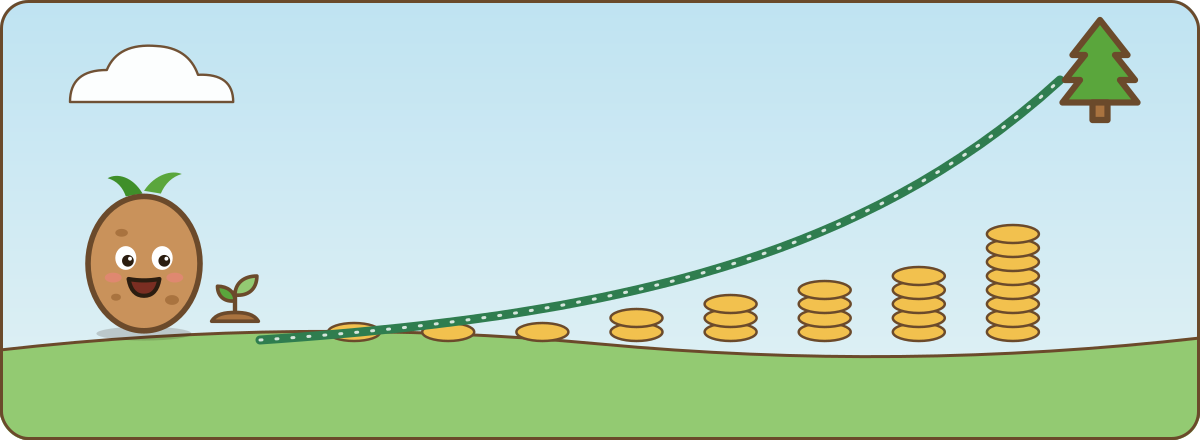
Growth that happens when the interest or returns an investment earns are added back to the original balance, so future growth is calculated on a larger and larger amount over time — growth on top of growth.
Simple interest pays you based only on your original deposit, forever. Compound interest pays you based on your original deposit plus everything it's already earned — so the amount you're earning interest on keeps growing every single year. It starts slow, but the snowball effect becomes dramatic over long stretches of time, which is exactly why starting early matters so much more than most people expect.
$10,000 growing at 7% a year is worth about $19,672 after 10 years — but $76,123 after 30 years. It didn't just triple over the extra 20 years; it grew nearly 4x more, because the later years are compounding on a much bigger base than the early years were.
Compound interest is interest earned on both your original money and on the interest it has already earned. Because each period's growth is added to the balance, the amount growing keeps getting larger, so growth speeds up over time.
How compound interest works
With simple interest, you earn the same amount each year, based only on the original deposit. With compound interest, each period's interest is added to the balance, and the next period's interest is calculated on the new, larger balance.
The standard formula is:
Future value = P x (1 + r/n)^(n x t)
- P = starting amount
- r = annual interest rate (as a decimal)
- n = compounding periods per year (1 for yearly, 12 for monthly)
- t = number of years
The three levers are the rate, the time, and how much money goes in. Time is the one people underestimate most, because the biggest gains come in the later years when the balance is largest.
A worked example
Compounding versus simple interest. Say $5,000 earns 5% a year, compounded yearly, for three years.
| Year | Calculation | Balance |
|---|---|---|
| 1 | $5,000 x 1.05 | $5,250.00 |
| 2 | $5,250 x 1.05 | $5,512.50 |
| 3 | $5,512.50 x 1.05 | $5,788.13 |
The year-three figure is rounded to the cent ($5,788.125). With simple interest, the same deposit earns $250 every year: $5,000 + (3 x $250) = $5,750. Compounding added an extra $38.13, small at first but growing every year.
Regular contributions over a long period. Now say someone invests $300 at the end of each month for 30 years and assumes a 6% annual return, compounded monthly (0.5% a month). This return is an assumption for illustration, not a forecast.
- Total contributed: $300 x 360 months = $108,000
- Future value: $300 x ((1.005^360 - 1) / 0.005) = $301,354.51
- Growth from compounding: $301,354.51 - $108,000 = $193,354.51
About 64% of the ending balance is growth rather than money put in. The compound interest calculator shows the same thing with your own amounts.
Compound interest in Canada
Tax decides how much of the compounding you keep:
- In a TFSA, interest, dividends and capital gains are generally not taxed, even when withdrawn, so the full return can compound. The 2026 annual limit is $7,000.
- In an RRSP, growth is not taxed while it stays in the account; withdrawals are taxed as income.
- In a non-registered account, interest is reported on your return each year (including interest that has built up on GICs and term deposits even before it is paid), which slows compounding. By comparison, only 50% of a capital gain is taxable in 2026, and only when you sell.
Fees compound too. A fund's MER is taken every year, so it reduces the base that future growth builds on. The investment fee calculator shows how that adds up.
Common mistakes
- Waiting to start. Each year of delay removes a year of growth from the end, when growth is largest.
- Using an advertised rate as a guaranteed return. Savings and GIC rates are stated in advance; stock market returns are not and should be treated as assumptions.
- Ignoring compounding on debt. A credit card balance compounds against you.
- Interrupting the process. Withdrawing growth resets the base that future growth builds on.
- Overlooking inflation. A nominal 6% is worth less in real terms once rising prices are counted.
How it connects
Compound interest is the engine behind total return, Coast FIRE and most long-term plans. For the story behind it, see compound interest explained and Benjamin Franklin's two-century experiment.
Frequently Asked Questions
Related Terms
Watch your own numbers compound.
Try the Compound Interest Calculator →