
A money lesson sticks when you feel the consequence. Telling a teenager that credit card interest is 20% a year is easy to nod along to. Watching a balance they ignored grow in a game, and having to choose which bill to skip, teaches it in a way a worksheet rarely does.
The trouble is that most money games are American. They use US taxes, 401(k)s and Social Security, which can confuse a Canadian student more than help. This guide sorts the free options by what they teach, and flags which ones follow Canadian rules.
The Games at a Glance
| Game | Best for | What it teaches | Canadian rules? | Cost |
|---|---|---|---|---|
| AlgoPotato (ours) | Ages 13+, self-paced | Debt, saving, investing, TFSA, RRSP and FHSA, taxes | Yes | Free, no account |
| ChatterHigh | Classrooms, grades 6–12 | Budgeting, cards, taxes, insurance | Yes | Free courses |
| Learn About Your Taxes (CRA) | A first job | Reading a T4, filing a return, benefits | Yes | Free |
| SPENT | A short, memorable lesson | Living paycheque to paycheque | No (US) | Free |
| NGPF Arcade | Topic by topic | Credit, interest, insurance, college costs, investing | No (US) | Free |
| Iconomix | Economics class | Markets, prices, shared resources | Not country-specific | Free |
| The Game of Life | Family game night | Careers, family and retirement choices | No | Board game |
AlgoPotato: Canadian Rules, Played Fast
AlgoPotato is our own game, so weigh this section accordingly. You start with an entry-level job, $0 in the bank and $114,000 of debt: a student loan, a car loan and a credit card charging 20.99%. Every second in the game is an hour, so months pass in minutes and compound interest becomes something you can watch work, for you or against you.
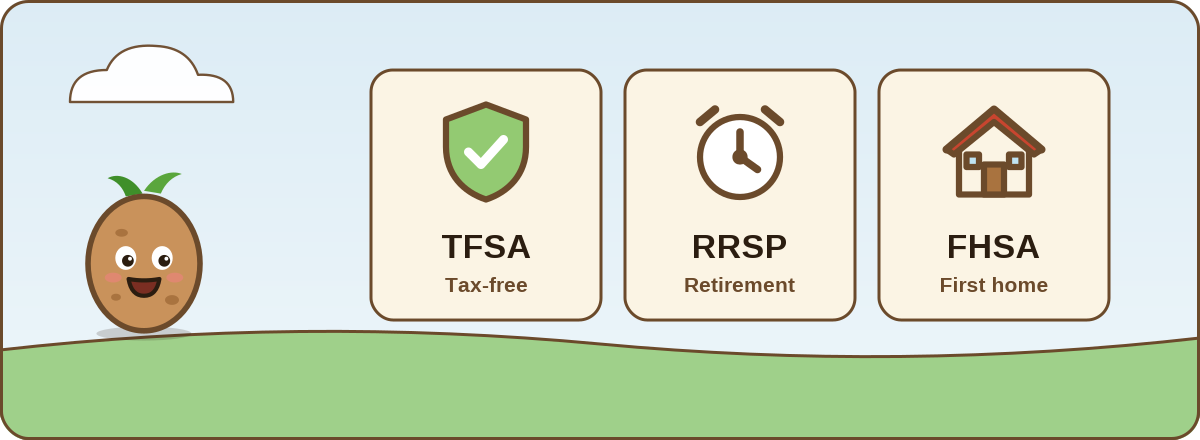
The game uses Canadian rules throughout: TFSA, RRSP and FHSA room and withdrawals, tax brackets, the Canada Child Benefit, CPP and OAS, and Bank of Canada rate changes. Players choose a career path for each life (university, skilled trades or a startup), buy insurance or take the risk, live through market crashes, and retire on the 4% rule. It runs in any browser on phones and computers, with no download and no account, and progress saves on the device.
Best for: teens who like strategy and idle games, and anyone who wants the Canadian versions of the accounts they will actually open. How to play explains the rules in ten minutes.
ChatterHigh: Built for Canadian Classrooms
ChatterHigh is a Canadian learning platform that turns courses into quizzes and competitions. It offers free, curriculum-aligned courses, including the Canada Revenue Agency's Learn About Your Taxes and the Financial Consumer Agency of Canada's Money Management Foundations (budgeting, saving, debit and credit cards). It has also run free national competitions for grades 6 to 12, most recently from January to March 2026.
Best for: teachers who want something curriculum-aligned and bilingual, with class results to look at afterwards.
The CRA's Learn About Your Taxes
Not a game in the arcade sense, but the closest thing to a tax simulator a Canadian teen will find. The Canada Revenue Agency's free course works through the basics in self-paced modules with scenarios: reading a T4, filing a return and getting the benefits you are owed.
Best for: anyone with a first part-time job. Filing a return, even on a small income, is how a young person starts building RRSP room and receives the GST/HST credit once they turn 19.
SPENT: A Month on the Edge
SPENT asks you to get through one month living paycheque to paycheque. Rent, food, surprise bills and requests from family and friends keep coming, every choice costs something, and some cost more later. It is short, and it starts good conversations about why budgeting is hard when there is no slack in it.
The catch: it is set in the United States, so health care and wages work differently. It is free and plays in the browser.
NGPF Arcade: One Game per Topic
Next Gen Personal Finance, an American non-profit, hosts twelve free games, each built around one topic:
- Credit Clash: building a strong credit score.
- Cat Insanity: interest rates, compounding and what minimum payments really cost.
- Bummer!: choosing insurance before a wheel of misfortunes spins.
- Payback: decisions on the way to and through college.
- Build your $TAX: twenty years of investing decisions, played out.
- The Uber Game: supporting a family as a gig driver.
The catch: American rules throughout (401(k)s, US student loans, US credit bureaus). The ideas carry over to Canada; the details don't. Teacher accounts add answer keys and assessments.
Iconomix: Economics, Not Budgeting
Iconomix, from the Swiss National Bank, collects classroom simulations of how an economy works: a fishpond game about shared resources and a market game where prices form as students trade. It suits a high school economics unit better than a personal finance one. The Bank of Canada Museum lists it among its learning resources for grades 7 to 12.
The Game of Life: A Conversation Starter
The classic board game walks players through school, careers, family and retirement. Luck decides most of it, so it teaches little about managing money. What it does well is start conversations at the table: why did the doctor career pay more, what does insurance protect, and what would you do differently in real life?
What Makes a Money Game Worth Playing
- Consequences that build over time. Interest, compounding and debt only make sense when you can see them grow.
- Rules that match where you live. A Canadian teen will open a TFSA, not a Roth IRA.
- Real trade-offs. If every choice is obviously right or wrong, it is a quiz, not a game.
- No real money. Avoid "games" that involve real trading, crypto or in-app purchases for students.
For Parents and Teachers
The game is the hook; the conversation afterwards is the lesson. After 15 to 20 minutes of play, ask three questions:
- Which decision cost you the most, and when did you notice?
- What would you do differently on a second try?
- How does that work in real life in Canada? (This is where a TFSA vs RRSP vs FHSA guide or the compound interest calculator helps.)
If a student enjoys the investing side, Games That Teach Investing goes further, from idle games to stock market simulators.
Practice With Real Numbers
Savings Goal Calculator
See how long it takes to save for something real.
Debt Payoff Calculator
Watch interest pile up, then pay it down faster.
Compound Interest Calculator
See what starting at 16 instead of 30 is worth.
Frequently Asked Questions

This article is educational content, not financial advice. AlgoPotato is our own game; we have no relationship with the other games listed. Game features and availability change, so check each site before assigning a game in class.
Play AlgoPotato right here

No download, no sign-up. Progress saves in your browser and carries over to the full-screen game.