
Is It Worth Spending Money on a Better Environment?
Often, yes, but less often than marketing suggests. Paying for a better environment (a gym, a coworking desk, a community, a course, a home closer to work) is worth it when it changes a behaviour that pays off and the free version has not done the job. It is lifestyle creep when you are paying for the feeling or the status of being someone who goes there.
The people, places and routines around you shape how you work, exercise, spend and save. This guide covers what the research says, a 5-question test for any environment purchase, free versions of the expensive options, and the Canadian tax rules that can make some of it cheaper.
Key takeaways
- Environments change behaviour, and behaviour drives money: income, health and spending.
- Pay for behaviour, not identity. The question is what you will do differently, not who you will feel like.
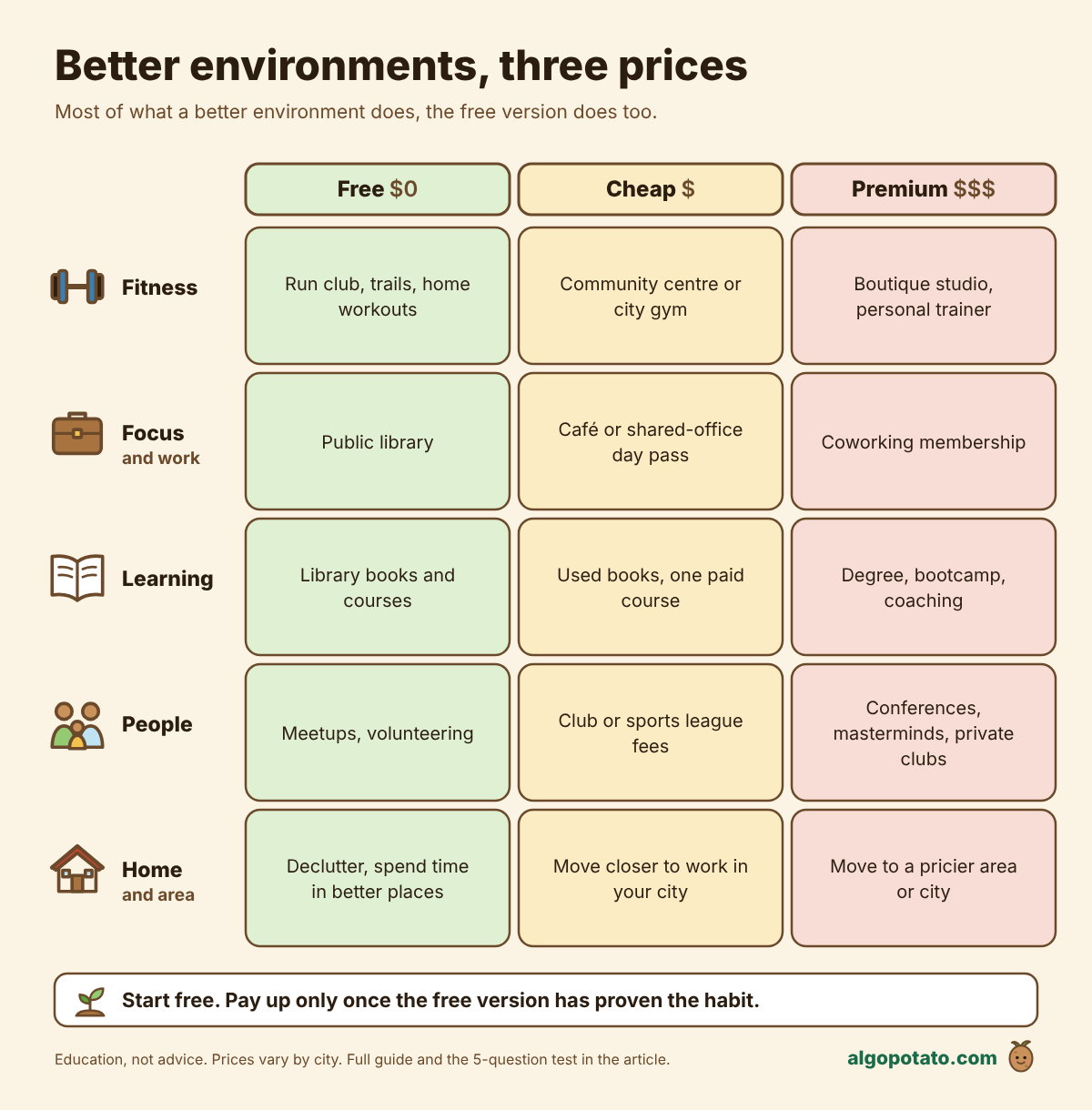
- Start free. Libraries, run clubs, meetups and volunteering give much of the benefit for $0.
- Watch the comparison trap. Richer surroundings can raise your spending: a Canadian lottery study found neighbours of big winners borrowed more and went bankrupt more often.
- Count the opportunity cost. $300 a month invested at 6% a year for 20 years would be about $132,000.
- Some of it is tax-deductible in Canada: qualifying moves, eligible tuition, professional dues, and business workspace for the self-employed.
Get this guide as a free printable PDF (6 pages, with a worksheet) ↓
Why Environment Matters for Money
Willpower is unreliable; surroundings are always on. What you see, who you spend time with and what is easy all nudge you, every day, without asking. Two well-known studies show how strong that nudge can be:
- Neighbours change how you spend. Researchers studied lottery winners in a Canadian province and found that a larger win by one neighbour was followed by more borrowing and more bankruptcies among the other neighbours nearby. An earlier version of the study found the neighbours spent more on visible things, like cars. Living near people who spend more pulls your spending up (Agarwal, Mikhed and Scholnick, Review of Financial Studies, 2020).
- Neighbourhoods change what children earn. In the US Moving to Opportunity experiment, children whose families moved to lower-poverty neighbourhoods before age 13 earned about 31% more in their mid-twenties than children who did not move. The longer they lived in the new area, the bigger the gain (Chetty, Hendren and Katz, American Economic Review, 2016).
So environments matter, in both directions. The first study is the warning: a "better" environment measured by how rich it looks can make your finances worse.
The 5-Question Test
Before you pay for a better environment, answer these five questions.
- What will I do differently? Name the behaviour: "train three times a week", "four days of focused work", "meet people in my field monthly". If you cannot name it, you are buying a feeling.
- Have I tried the free version? If you will not run with a free run club, a $200-a-month studio is unlikely to fix it. If the free version works but hits a limit, paying for the next level makes sense.
- What is the cost per use? Divide the yearly cost by how often you will really go. A $600 yearly membership used 100 times is $6 a visit; used 10 times, it is $60.
- Will it raise my spending elsewhere? Some environments come with expensive norms: the drinks after the class, the wardrobe for the club, the restaurant your new circle picks.
- What would the money become if invested? The opportunity cost is real. Run it through the compound interest calculator before you sign an annual contract.
Pass all five and the spending is an investment in yourself. Fail two or more and it is probably lifestyle creep.
Free Versions of Expensive Environments
| Environment | What it does for you | Free or cheap version |
|---|---|---|
| Gym or studio | Routine, equipment, people expecting you | Run clubs, free weekly 5 km runs (parkrun runs in many Canadian cities), trails, home workouts, municipal recreation centres (many cities offer low-income discounts) |
| Coworking space | Focus, separation from home, other people working | Public libraries, a regular café morning, a work-together session with a friend, a one-day pass before a membership |
| Courses and coaching | Structure, feedback, deadlines | Library books and e-learning (many Canadian public libraries include online course platforms with a free card), free university courses, a study partner |
| Conferences and masterminds | Ideas and people a step ahead of you | Local meetups, professional associations' free events, volunteering at the conference (often free entry), an accountability partner |
| Private clubs | Status, a network | Volunteering, community boards, sports leagues: people meet through shared work, not shared bills |
| A pricier neighbourhood | Shorter commute, safety, schools, amenities | Moving closer to work within your budget, spending your free time in better public places (parks, libraries, community centres) |
When Paying More Is Worth It
Spending on environment earns its keep in a few clear cases:
- It removes a real bottleneck. You work from home with small children and cannot focus: a coworking desk two days a week can be worth far more than it costs if your income depends on output.
- It buys back time. A home closer to work that saves an hour of commuting a day gives you over 200 hours a year. Weigh the extra rent against what those hours are worth to you.
- It puts you near opportunity. For a career, being where the work and the people in your field are can raise your income for decades. That is the adult version of the neighbourhood effect.
- It is for your children. The Moving to Opportunity results suggest the earlier and longer children live in a better neighbourhood, the bigger the effect. For families, schools and neighbourhood can be among the highest-return spending there is, as long as the housing cost leaves room to save.
- The free version worked, and you outgrew it. That is the best sign of all.
When It Is Lifestyle Creep
- You signed an annual contract on a January resolution.
- You are paying for the brand: the studio you post about, the club you mention.
- Your new circle spends far more than you do, and you have started to match it.
- The cost per use keeps rising because you go less.
- Your savings rate dropped and you cannot say what you got for it.
Read more in Lifestyle Creep Explained.
Make It a Budget Line
Give environment spending its own line in your budget, next to savings, instead of letting it hide in "miscellaneous". Then:
- Start at $0. Use the free versions for a month or two.
- Pay monthly, not yearly, until a habit has lasted three months.
- Review every 90 days. Keep what you use and what changed your behaviour; cancel the rest.
- Check your savings rate after every new cost. Self-investment should come out of spending, not out of saving.
An example of the opportunity cost: a $300-a-month coworking membership costs $3,600 a year. Invested instead at 6% a year for 20 years, that money would grow to about $132,000. If the desk raises your income by more than $3,600 a year, it can still be the better investment. If it does not, it is an expensive habit.
Canadian Tax Rules That Can Help
- Moving for work or school. If your new home is at least 40 km closer to a new job, business or full-time school, moving costs can be deductible (movers, travel, up to 15 days of temporary lodging, and more). See the CRA's rules for moving expenses.
- Tuition. Courses at eligible institutions can qualify for the federal tuition tax credit, and the refundable Canada Training Credit can cover part of the cost: your available amount is shown on your notice of assessment.
- Professional and union dues are deductible.
- Coworking for the self-employed. If you run a business, a workspace used for it is usually a business expense.
- Not deductible for most people: gym and studio memberships, social clubs, and coworking you pay for as an employee.
Tax rules have conditions and change over time: check the CRA's guidance or a tax professional before you count on a deduction.
See what a monthly membership would grow to if you invested it instead.
Compound Interest Calculator →Research cited: Agarwal, Mikhed and Scholnick, "Peers' Income and Financial Distress: Evidence from Lottery Winners and Neighboring Bankruptcies", Review of Financial Studies 33(1), 2020; Chetty, Hendren and Katz, "The Effects of Exposure to Better Neighborhoods on Children", American Economic Review 106(4), 2016. Canadian tax rules as of October 2026. The 6% return in the example is an assumption, not a forecast. This article is education, not financial or tax advice: see our editorial policy and disclaimer.
Related Calculators
Compound Interest
See what a monthly membership would grow to if invested instead.
Savings Rate Calculator
Check that self-investment still leaves room to save.
Savings Goal
Save up for a course or a move before you pay for it.
FIRE Calculator
See how your spending choices move your retirement date.
Frequently Asked Questions



Play AlgoPotato right here

No download, no sign-up. Progress saves in your browser and carries over to the full-screen game.