
What Is the Difference Between Insurance and Self-Insurance?
Buying insurance means paying a company a premium so it pays for a loss if it happens. Self-insurance means keeping that premium and paying for the loss from your own savings if it happens. Both are ways to handle the same risk; the question is which one costs you less for the protection you need.
The short answer: insure the losses you could not pay, and self-insure everything else. The rest of this guide shows how to tell the two apart, with the Canadian rules for car, home, life, disability, health and travel insurance.
Key takeaways
- Insurance costs more than it pays out, on average. You buy it for losses that would wreck your finances, not to come out ahead.
- The one-question test: could you pay this loss tomorrow from savings, without debt? If yes, self-insure. If no, insure.
- Always insure: liability (car and home), your ability to earn (disability), your income for dependants (term life), and medical care outside Canada.
- Usually self-insure: phones, extended warranties, small repairs and routine costs.
- Self-insurance only works if the money exists: an emergency fund in a savings account, not a credit card.
- Raise your deductibles once your emergency fund can cover them: it is the cheapest self-insurance there is.
Why Insurance Costs More Than It Pays
An insurer collects premiums from many people, pays the claims of the few who have a loss, and keeps the rest to cover its staff, its sales commissions, its reserves and its profit. So across all its customers, premiums must be larger than the claims it pays. For you, that means the expected cost of buying insurance is always higher than the expected cost of carrying the risk yourself.
That is not a reason to skip insurance. It is a reason to buy it for the right things. Insurance turns a small chance of a ruinous loss into a small, certain cost. That trade is worth paying extra for when the loss would mean losing your home, your savings or your future income. It is a bad trade when the loss is a cracked screen.
The One-Question Test
Could I pay this loss tomorrow, from money I already have, without debt and without derailing my plans?
- No → buy insurance. The premium is the price of not being ruined.
- Yes → self-insure. Keep the premiums, and keep the money ready.
Two things change the answer over time. As your emergency fund and net worth grow, more losses become ones you could pay, so you can self-insure more. And as people start to depend on your income, the cost of losing that income grows, so you need more of some insurance (life and disability) for a while.
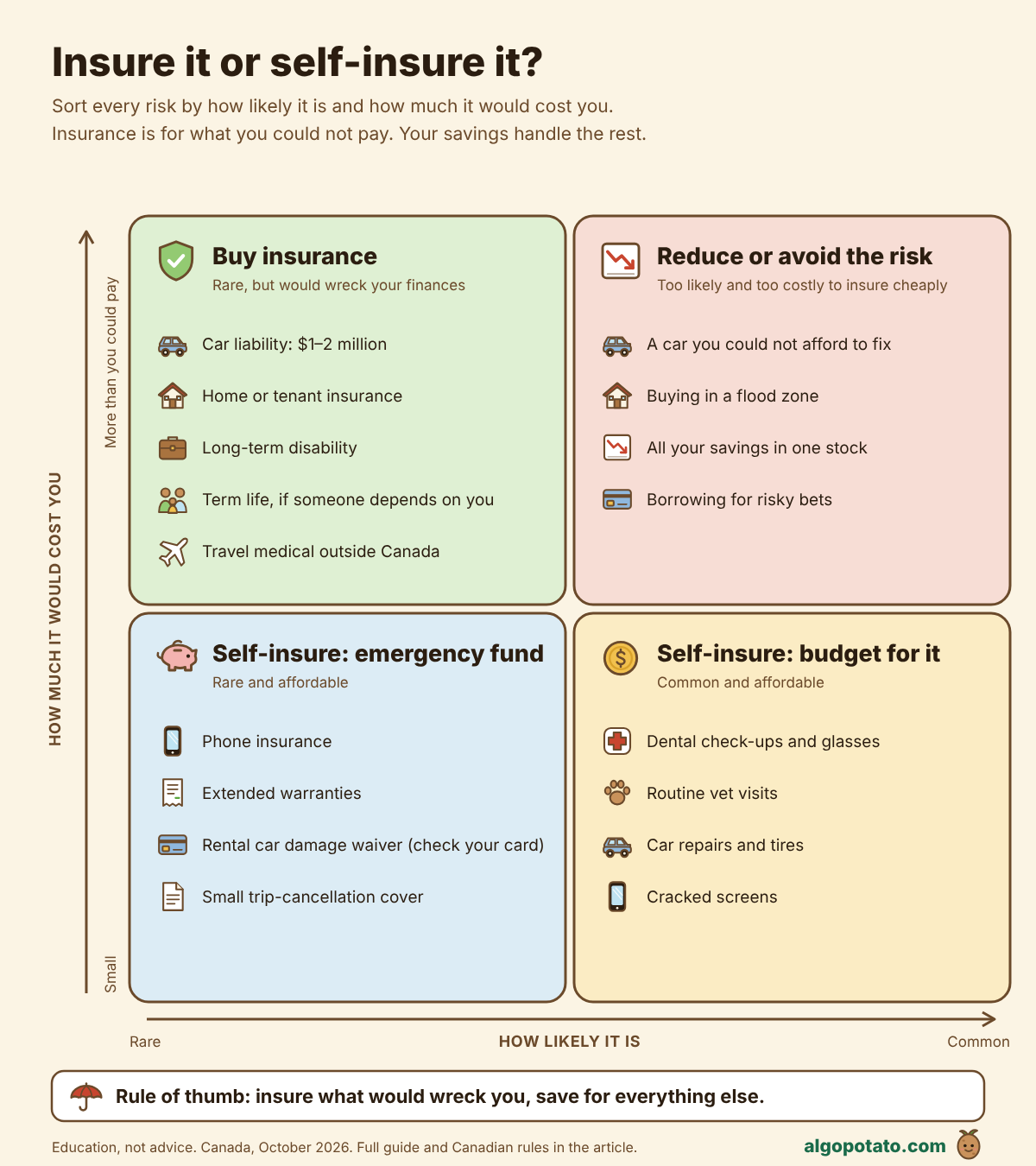
The Risk Matrix
Sort every risk by two questions: how likely is it, and how much would it cost you?
| Rare | Common | |
|---|---|---|
| Would wreck your finances | Buy insurance. Liability, disability, term life with dependants, home rebuild, travel medical. | Reduce or avoid it. Insurance is expensive or unavailable: change the plan instead. |
| You could pay it | Self-insure from an emergency fund. Phone insurance, extended warranties, rental car waivers. | Budget for it. Dental check-ups, glasses, routine vet visits, car maintenance. |
The top-right box is the one people miss. When a big loss is likely, insurance gets very expensive, because the insurer expects to pay. A car you could not afford to fix, a house in a flood zone, or all of your savings in one stock are risks to shrink, not to insure.
Insure or Self-Insure? Type by Type in Canada
| Insurance | Usually | Why |
|---|---|---|
| Car: third-party liability | Buy, by law, and buy more than the minimum | Every province requires it: at least $200,000 in most provinces. Injuring someone can cost millions, and $1–2 million of liability usually costs little more. |
| Car: collision and comprehensive | Self-insure on an older car | If the car is worth a few thousand dollars and your emergency fund could replace it, the premium may not be worth it. Keep it on a newer, financed or leased car (lenders require it). |
| Home insurance (owners) | Buy | Rebuilding a home is the loss few people could pay. Your mortgage lender will require it. Check whether overland flood and sewer backup are included or need an add-on. |
| Tenant insurance | Buy | It is cheap and includes liability: if a fire starts in your unit and damages others, you could be sued. Many landlords require it. |
| Umbrella liability | Consider as your net worth grows | Extra liability on top of car and home, for the rare large lawsuit. The more you own, the more you have to protect. |
| Long-term disability | Buy, if you rely on a paycheque | Your ability to earn is likely your biggest asset. EI sickness benefits pay at most 26 weeks, at 55% of your earnings up to $729 a week in 2026. Check your workplace plan first, and whether it ends when you leave the job. |
| Term life insurance | Buy, while someone depends on your income | Children, a partner, a mortgage in two names. Once your savings could replace that income, you are self-insured and can let it end. |
| Whole or universal life | Rarely the best fit | Much more expensive than term for the same coverage. It can make sense for specific estate or business plans; most families do better with term life and investing the difference. |
| Mortgage life insurance from your lender | Compare with term life first | The payout shrinks as you pay down the mortgage, the lender is the beneficiary, and some policies only check your health when you claim. A personal term policy is often cheaper and more flexible. |
| Critical illness | Optional | A lump sum if you are diagnosed with a covered illness. A strong emergency fund and disability coverage cover much of the same need. |
| Travel medical outside Canada | Always buy | Provincial health plans cover little or nothing of a hospital bill abroad, and in the US a short stay can cost tens of thousands of dollars. |
| Drug, dental and vision | Take a workplace plan if offered; otherwise compare | Without a plan, compare premiums with what you actually spend. Families with adjusted net income under $90,000 and no dental coverage may qualify for the Canadian Dental Care Plan. |
| Pet insurance | Either | If a $5,000 emergency vet bill would hurt, consider accident and illness cover. Otherwise build a pet fund. |
| Phone insurance, extended warranties, appliance plans | Self-insure | Small, affordable losses at high prices. Put the monthly fee into savings instead. |
| Rental car damage waiver | Check your credit card first | Many cards include rental car damage cover when you pay with the card. Read its terms before you pay the counter's daily rate. |
Provincial rules differ, especially for car insurance (British Columbia, Saskatchewan and Manitoba have public insurers, and Quebec has a public plan for injuries). Always read the policy wording: exclusions matter more than the headline.
Deductibles: The Cheapest Self-Insurance
A deductible is the part of a claim you pay yourself. Choosing a higher one is partial self-insurance: you take the first slice of every loss, and the insurer charges you less for the rest.
An example with made-up numbers: say raising your car's collision deductible from $500 to $1,000 cuts the premium by $120 a year. You save $120 every year, and pay an extra $500 only in a year you claim. If you claim less than about once every four years, the higher deductible comes out ahead. Get real quotes: the saving varies a lot by insurer, province and driver.
The condition: the higher deductible must be money you have. Raise deductibles as your emergency fund grows, never ahead of it.
How to Self-Insure Properly
- Build the fund first. Three to six months of spending in a high-interest savings account or short GICs. This is your self-insurance pool.
- Keep it safe and quick to reach. Not in stocks, which can be down 30% the month you need them. A TFSA savings account works well, and deposits at a CDIC member are insured up to $100,000 per category (see CDIC vs CIPF).
- Add sinking funds for the common stuff. A small monthly amount for car repairs, dental, glasses and the vet turns "emergencies" into planned spending in your budget.
- Never self-insure with debt. If a loss would go on a credit card at 20% interest, you are not self-insured: you are uninsured.
- Refill it after you use it. A fund that is half empty covers half the risk.
- Redirect the premiums you drop. Cancel the phone plan or the extended warranty, and send that money to the fund automatically.
When You Become Self-Insured
The goal of building wealth is, in part, to need less insurance. Life insurance is the clearest case. Say your family would need $750,000 to replace your income until the children are grown. You buy a 20-year term policy for that amount. As your portfolio grows, the gap it covers shrinks, and once your investments alone could provide that $750,000, you can let the policy end.
The same happens elsewhere: a large emergency fund lets you carry high deductibles and skip small policies, and financial independence makes income protection less critical. Liability is the exception: the more you own, the more a lawsuit could take, so liability coverage often goes up as you get richer.
Common Mistakes
- Insuring the small and under-insuring the big. Paying for phone insurance while carrying only the minimum car liability is the classic mix-up.
- Relying only on workplace coverage. Group life and disability usually end when the job ends.
- Letting a policy lapse. Coverage you stop paying for is gone, and you may not get it back at the same price after a health change.
- Not reading the exclusions. Overland flood, home businesses and high-value items are common gaps in home and tenant policies.
- Calling a credit card an emergency fund. It is a loan at a high rate, not savings.
- Buying insurance as an investment. Keep protection and investing separate unless you have a specific reason not to.
Build the emergency fund that makes self-insurance work.
Savings Goal Calculator →Figures for Canada, October 2026: EI sickness benefits from canada.ca; Canadian Dental Care Plan income limit from Government of Canada information; car insurance minimums from provincial rules as summarized by the Insurance Bureau of Canada. Rules and limits change. This article is education, not insurance or financial advice: see our editorial policy and disclaimer. For advice on your situation, talk to a licensed insurance advisor.
Related Calculators
Savings Goal
Plan the monthly saving that builds your emergency fund.
Net Worth Tracker
See when your savings could cover a loss on their own.
FIRE Calculator
Find the portfolio that would let you drop life insurance.
Savings Rate Calculator
Free up the cash that self-insurance runs on.
Frequently Asked Questions


Play AlgoPotato right here

No download, no sign-up. Progress saves in your browser and carries over to the full-screen game.