The Tax-Free Savings Account is the most flexible account most Canadians will ever open, and the most misunderstood. Its name says "savings account", so people treat it like one. It is really a container: you decide what goes inside, and whatever it earns is never taxed.
Key takeaways
- It is an account, not an investment: a TFSA can hold cash, GICs, ETFs, stocks or bonds. What you hold decides what it earns.
- No tax on growth or withdrawals: you contribute money that has already been taxed, and nothing comes out taxed again.
- The 2026 limit is $7,000: unused room carries forward, so someone eligible since 2009 has $109,000 of room.
- Withdrawals come back, later: money you take out is added back to your room on January 1 of the next year, not right away.
- Over-contributing costs 1% a month on the excess, so track your room before you deposit.
How a TFSA Works
Four rules cover most of it:
- You contribute after-tax money. There is no deduction when you put money in, unlike an RRSP.
- Growth is tax-free. Interest, dividends and capital gains inside the account are not taxed while they stay there.
- Withdrawals are tax-free. You can take money out at any time, for any reason, and it is not income on your tax return.
- Room is limited, but it accumulates. Each year adds new contribution room, and room you do not use carries forward forever.
To open one you need to be 18 or older, have a valid Social Insurance Number, and live in Canada. Banks, credit unions, online brokerages and robo-advisors all offer them. You can have more than one TFSA, but the contribution room is shared across all of them.
How Much You Can Put In
The federal government sets a new limit each year, indexed to inflation and rounded to the nearest $500. Your room starts the year you turn 18 (if you live in Canada), whether or not you open an account.
| Years | Annual limit |
|---|---|
| 2009 to 2012 | $5,000 |
| 2013 and 2014 | $5,500 |
| 2015 | $10,000 |
| 2016 to 2018 | $5,500 |
| 2019 to 2022 | $6,000 |
| 2023 | $6,500 |
| 2024 to 2026 | $7,000 |
| Total, 2009 to 2026 | $109,000 |
Two examples:
- Eligible since 2009, never contributed: $109,000 of room in 2026.
- Turned 18 in 2020: the limits for 2020 to 2026 add up to $45,500.
Your exact number, after past contributions and withdrawals, is in CRA My Account. The TFSA room calculator gives a quick estimate.
Withdrawals: Tax-Free, but the Room Comes Back Later
This is the rule that trips people up. When you withdraw, the amount is added back to your contribution room, but only on January 1 of the following year.
Say Maya has used all her room. In March 2026 she withdraws $5,000 for a car repair. If she puts the $5,000 back in June 2026, she has over-contributed by $5,000, because that room only returns on January 1, 2027. If she waits until January, she gets the $5,000 back plus the new 2027 limit.
Moving money between two of your own TFSAs is different: ask for a direct transfer between institutions, and it does not count as a withdrawal or a contribution. Taking the cash out yourself and depositing it at the other bank does.
Over-Contributions Cost 1% a Month
If you put in more than your room, the CRA charges a tax of 1% a month on your highest excess amount in each month it stays in the account. A $5,000 excess costs $50 a month. It stops when you withdraw the excess or when new room arrives on January 1. If it was an honest mistake you corrected quickly, you can ask the CRA to waive the tax.
Does a TFSA Earn Interest?
Not on its own. People search for "TFSA interest" because banks advertise "TFSA savings accounts", but the TFSA is only the wrapper. The return comes from what is inside:
- A TFSA savings account pays the bank's interest rate.
- A TFSA GIC pays a fixed rate for a fixed term.
- TFSA ETFs or stocks earn whatever the market gives, including losses.
The interest itself is calculated the same way as in any account. The difference is tax. Interest is fully taxable in a regular account, so at a 30% marginal tax rate a 3% interest rate keeps only 2.1% after tax. Inside a TFSA you keep all of it:
| $10,000 at 3%, compounded monthly | After 1 year | After 10 years |
|---|---|---|
| In a TFSA | $10,304.16 | $13,493.54 |
| In a taxable account (30% tax rate) | about $10,212 | $12,334.52 |
Over ten years the TFSA comes out $1,159.02 ahead on the same savings rate, and the gap keeps widening because the untaxed interest compounds too.
Compound Growth Over a Career
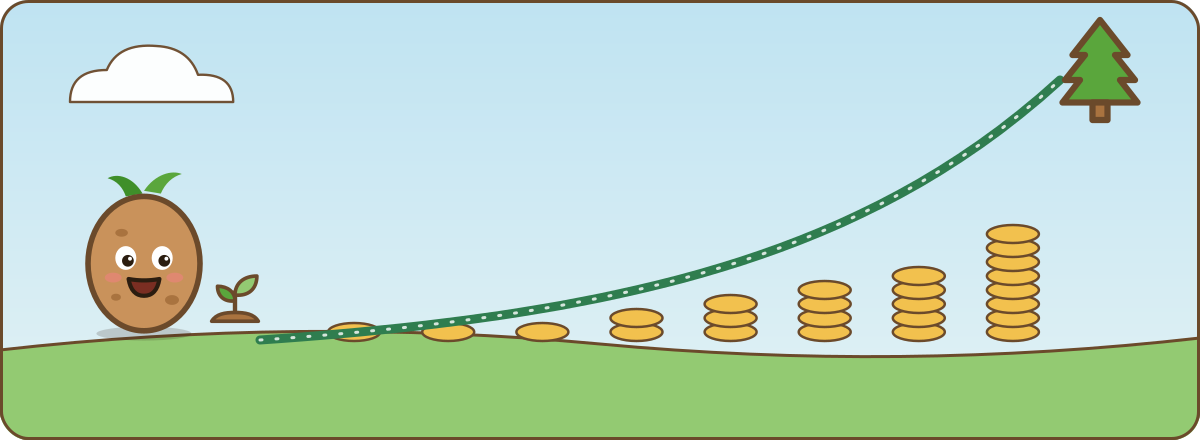
The bigger the return and the longer the time, the more the tax-free part is worth. If you contribute $7,000 at the start of every year for 30 years and earn 5% a year, you end with about $488,326: $210,000 of your own money and $278,326 of growth, all of it yours to withdraw tax-free. The 5% is an assumption for illustration, not a promise; real returns vary from year to year. The compound interest calculator lets you try your own numbers.
What You Can Hold
Most mainstream investments qualify: cash, GICs, government and corporate bonds, mutual funds, ETFs, and shares listed on designated stock exchanges, in Canada or abroad. Two things to know:
- US dividends lose 15% to US withholding tax, and a TFSA cannot recover it. Canadian dividends and growth-focused holdings avoid that drag. US withholding tax explains the details.
- Frequent trading can be taxed. If you trade so often that it looks like a business, the CRA can tax the profits as business income, TFSA or not.
TFSA, RRSP or FHSA?
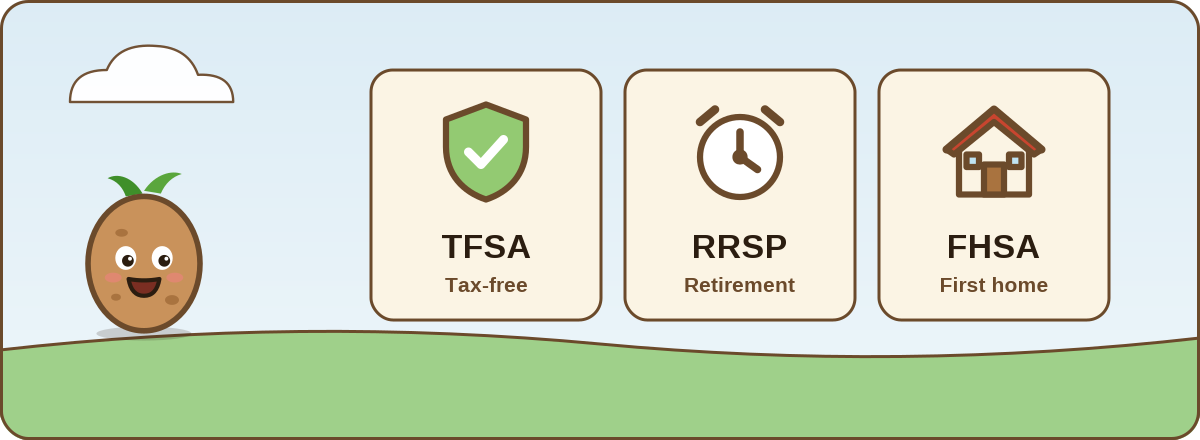
They solve different problems. The TFSA suits most people first because it is flexible and its withdrawals do not count as income. The RRSP gives a deduction now and taxes withdrawals later, which pays off when your income today is higher than it will be in retirement. The FHSA combines a deduction with tax-free withdrawals, but only for a first home. TFSA vs RRSP vs FHSA compares all three.
Moving Abroad, Death and Other Edge Cases
- If you become a non-resident, you can keep your TFSA and withdraw tax-free in Canada, but you do not gain new room, and contributions made while non-resident are taxed at 1% a month. Your new country may tax the growth.
- If you die, a spouse or common-law partner named as successor holder simply takes over the account. Other beneficiaries receive its value at death tax-free, though growth after death can be taxable.
Common Mistakes
- Leaving it in cash for years. A TFSA holding cash earns the cash rate; for long-term money, the tax shelter is worth more around investments that grow.
- Re-contributing a withdrawal in the same year without spare room.
- Assuming the bank tracks your room. Each institution only sees its own account; the CRA sees all of them, sometimes months late.
- Using it for short-term spending money only. It can do that, but every dollar of room spent on a chequing-account balance is room not compounding.
In AlgoPotato, your TFSA works the same way: room arrives every game year, withdrawals come back the next year, and investments inside it grow untaxed. It is a quick way to see the rules play out before you use the real one.
Work Out Your Numbers
TFSA Room Calculator
Your total contribution room from your birth year and history.
Compound Interest Calculator
See how money grows when returns stay invested.
RRSP vs TFSA Calculator
Which account leaves you more after tax.
Frequently Asked Questions


This article is educational content, not personalized financial or tax advice. TFSA limits and rules are set by the federal government and the Canada Revenue Agency and can change; check your own contribution room in CRA My Account before contributing.
Play AlgoPotato right here

No download, no sign-up. Progress saves in your browser and carries over to the full-screen game.