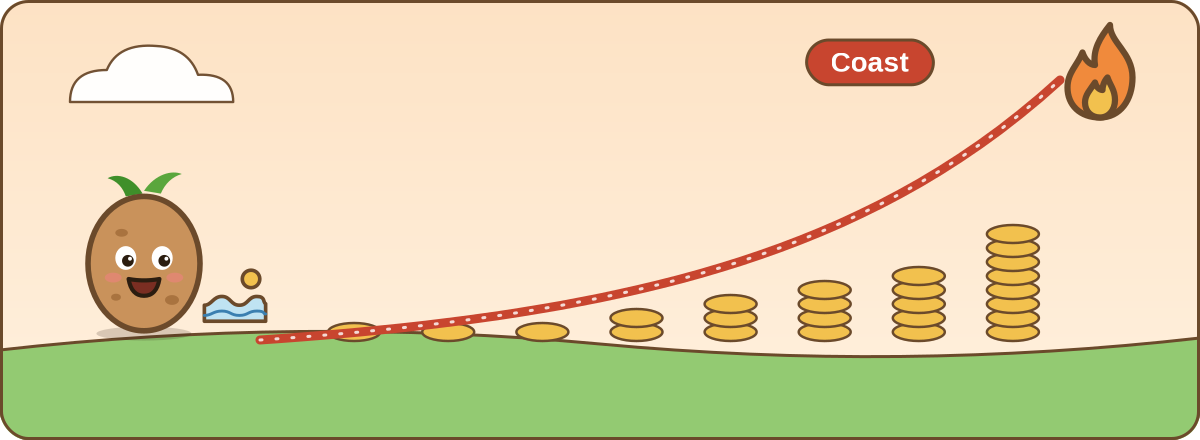
The point at which someone has invested enough that, left untouched, compound growth alone will reach their full retirement number by a traditional retirement age — meaning they can stop adding new savings and just cover current expenses.
Picture pushing a snowball down a long hill. At some point, it's rolling fast enough and it's big enough that it'll reach the bottom of the hill on its own — you don't need to keep pushing. Coast FIRE is that point for your investments: you've built up enough that time and compounding will finish the job by retirement age, even if you never invest another dollar. You still need to earn enough to cover today's bills, but the pressure to save aggressively is gone.
A 30-year-old with $140,000 invested, earning a 7% average return, would grow to roughly $1.5M by 65 with zero further contributions — without doing any more saving. If $1.5M happens to be their FIRE number, they've already hit Coast FIRE at 30.
Coast FIRE is the point where your investments are large enough that, with no new contributions, growth alone should carry them to your full retirement target by a chosen age. After that, you only need to earn enough to cover today's living costs.
How Coast FIRE works
You need three inputs:
- Your FIRE number: often 25 times annual spending, from the 4% rule.
- Years until your target retirement age.
- An assumed annual return. Using a return after inflation (a "real" return) keeps everything in today's dollars, so the FIRE number does not need to be inflated.
Then work backwards:
Coast FIRE number = FIRE number / (1 + return)^years
If your invested balance today is at or above that figure, you have reached Coast FIRE. The idea relies entirely on compound interest: money invested early has the most years to grow, so a relatively small balance in your 30s can do a lot of the work.
Reaching Coast FIRE does not mean you can stop working. Your paycheque still has to cover rent, groceries and everything else today; what changes is that saving for retirement becomes optional. Many people use that freedom to take a lower-paid job they enjoy more, cut back hours, or keep saving at a slower pace as a cushion.
A worked example
Say someone is 35, plans to retire at 65 (30 years away) and expects to spend $40,000 a year in today's dollars.
- FIRE number: $40,000 x 25 = $1,000,000
- Growth factor at an assumed 5% real return: 1.05^30 = 4.3219 (rounded to four decimals)
- Coast FIRE number: $1,000,000 / 4.3219... = $231,377.45
Check: $231,377.45 x 1.05^30 = $1,000,000.
The assumed return changes the answer a lot. Here is the same goal at two assumptions (both are assumptions, not forecasts; 7% after inflation is a common planning figure for broad stock markets):
| Assumed real return | Growth over 30 years | Coast FIRE number |
|---|---|---|
| 5% | x 4.3219 | $231,377 |
| 7% | x 7.6123 | $131,367 |
Results are rounded to the nearest dollar. Dropping the assumed return from 7% to 5% raises the amount needed by about 76% ($231,377 / $131,367 = 1.76), which is why many people plan with a cautious figure. The Coast FIRE calculator lets you test your own age, spending and return.
Coast FIRE in Canada
A few Canadian details shape the calculation:
- Account type matters at the end. A target held mostly in an RRSP will be taxed as income when withdrawn, so it needs to be larger than the same spending target held in a TFSA, where withdrawals are generally tax-free.
- Government pensions. CPP and OAS payments later in life can cover part of spending from their start dates, which some people subtract from the spending they need the portfolio to fund.
- Inflation. If you use a nominal return instead of a real one, you also need to grow the FIRE number by inflation. The Bank of Canada targets 2% inflation, within a 1% to 3% range.
Common mistakes
- Mixing nominal returns with today's-dollar targets. This overstates how far the money will go.
- Using an optimistic return. As the table shows, the plan is very sensitive to this one number.
- Forgetting fees. A fund's MER reduces the return you actually get each year.
- Withdrawing early. Coast FIRE only works if the balance is left alone to grow.
- Not rechecking. Spending, markets and plans change, so the coast number is worth recalculating every year or two.
How it connects
Coast FIRE is the softest form of FIRE: you stop saving but keep working. Barista FIRE goes a step further by drawing on the portfolio while working part-time. Our longer guide, Coast FIRE explained, covers who it tends to suit.
Frequently Asked Questions
Related Terms
See your own Coast FIRE number.
Try the Coast FIRE Calculator →